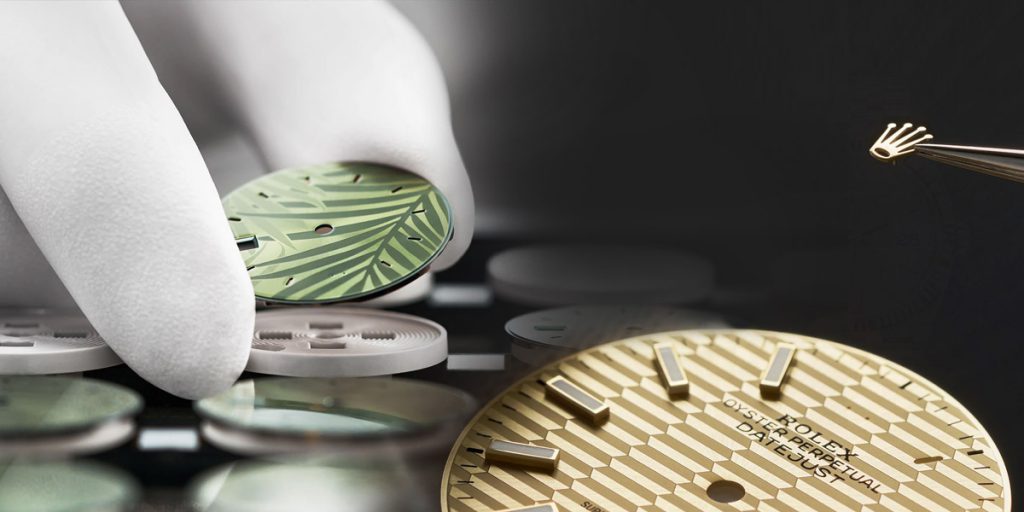
Clean Factory Watch Dial Craftsmanship: Lacquer, Sunray & Applique Standards
The watch dial serves as the primary visual interface of any luxury timepiece. Achieving true optical parity requires advanced metallurgical stamping, multi-layer varnish deposition, and precise pad printing rather than simple surface spraying. Clean Factory manufactures custom watch dials on solid brass substrates, deploying specialized finishing techniques—including deep lacquering, electroplated sunray brushing, and femtosecond laser motif engraving. This technical guide details our dial manufacturing workflow and quality verification metrics.
Dial Engineering Directory
1. Brass Substrate Milling & Surface Polishing Protocols
Every Clean Factory dial begins as a high-density, low-zinc brass alloy plate. CNC milling machines drill the precise center arbor hole, date window apertures, and mounting feet locations to tolerances within ±0.005mm. Before any coloring occurs, the blank disk undergoes multi-stage chemical deburring and diamond-paste mirror polishing to eliminate surface imperfections.
Figure 1: Microscopic inspection of Clean Factory brass dial blank edge finishing and mirror polish.
2. Multi-Layer Lacquering vs. Galvanic Sunray Electroplating
Different watch references require distinct surface metallurgy:
- Gloss Lacquered Dials (e.g., Black Submariner / White Daytona): Specialized acrylic varnishes are applied in cleanroom spray chambers. Multiple ultra-thin layers are baked in climate-controlled ovens, followed by clear-coat protective glazing to yield an enamel-like depth.
- Galvanic Sunray Dials (e.g., Datejust Blue/Green): Brass blanks are spun under brass-wire brushes to etch micro-radial lines. Disks are then immersed in electrolytic baths containing gold, silver, or rhodium ions for dynamic reflection.
- Laser Motif Dials (e.g., Palm & Fluted Patterns): Femtosecond laser cutters carve precise geometric channels into the brass base before galvanic coloring, producing sharp visual contrast.
Figure 2: High-magnification check of Clean Factory sunray radial pattern and 3D pad-printed text integrity.
3. High-Precision Pad Printing & Thermal Oven Curing
Inscriptions, minute tracks, and sub-dial indices are transferred using silicone transfer bulbs. Inks are custom-formulated for opacity and UV stability. To achieve crisp, 3D raised typography without ink bleeding, each color pass is printed separately and cured in thermal ovens at 120°C before subsequent passes.
4. Hand-Applied Hour Markers & Luminous Compound Filling
Hour-marker appliques (Roman numerals, batons, or geometric dots) are stamped from solid metal stock, diamond-cut along all bevels, and rhodium or 18k gold electroplated to prevent oxidation. Technicians manually position each marker using micro-tweezers under stereo microscopes, riveting them through rear dial feet.
Figure 3: Benchwork precision setting of 18k gold plated appliques and Chromalight luminous fills.
Batons and hands—detailed in our Solid Hands Guide—are filled with authentic Swiss Super-LumiNova pigments (Chromalight blue or C3 green). Completed dial assemblies are fitted to our 904L Steel cases during final Swiss-Standard Assembly.
5. Technical Specification Matrix: Clean Dials vs. Standard Replicas
| Manufacturing Metric | Clean Factory Precision Dials | Standard Market Replicas |
|---|---|---|
| Substrate Base | High-density low-zinc alloy brass disk | Cheap recycled copper/iron blank |
| Finish Execution | Multi-layer baked lacquer & galvanic electroplating | Single-pass spray paint (fades quickly) |
| Typography Crispness | 3D pad-printed with thermal oven curing | Flat screen printing with fuzzy text edges |
| Hour Marker Fixation | Riveted rear dial feet; diamond-bevel polish | Surface glued (markers fall off easily) |