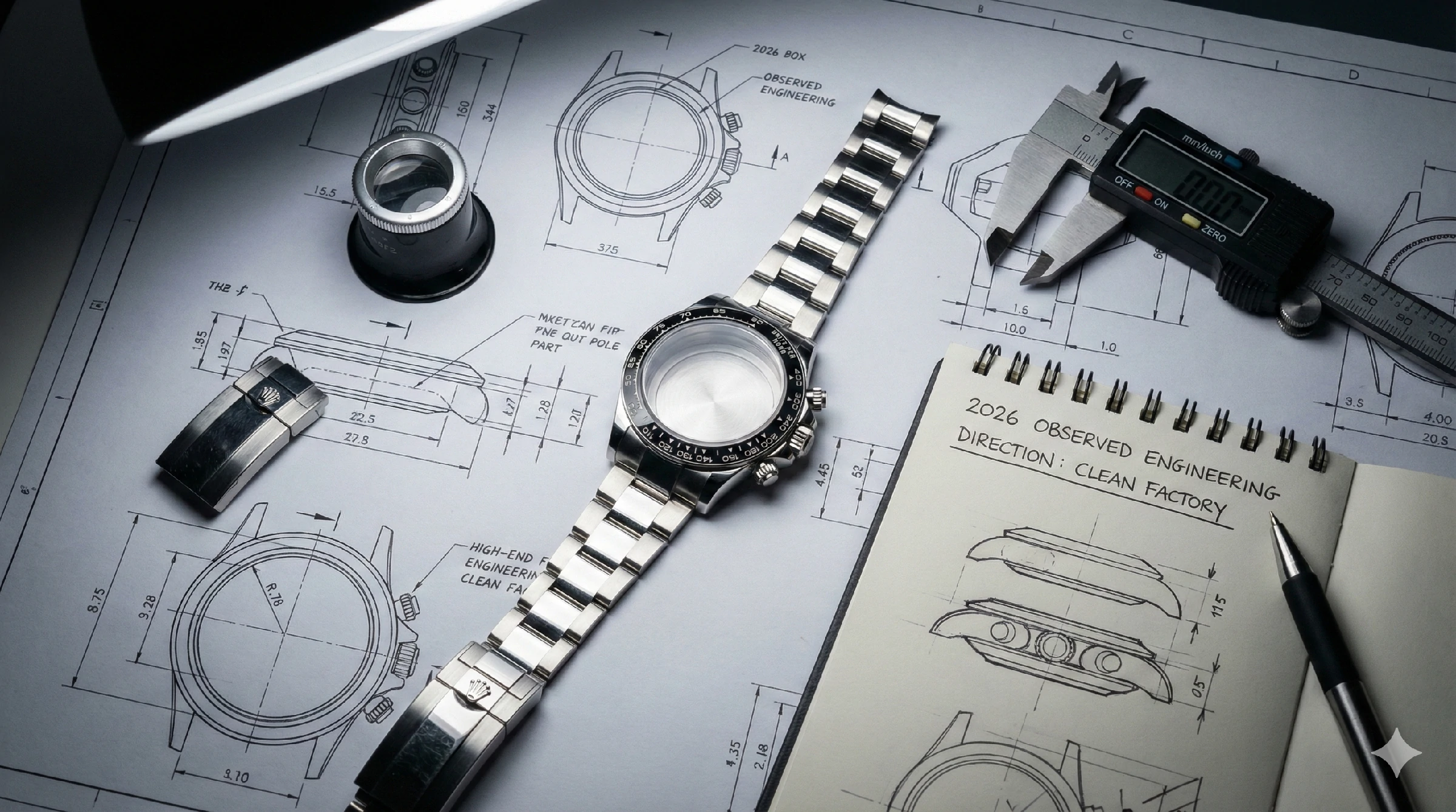
As the high-end replica watch segment moves deeper into 2026, the discussion among experienced collectors has become noticeably more restrained. Visual similarity alone no longer defines quality. Instead, attention has shifted toward mechanical behavior, structural coherence, and how a watch performs after extended daily wear rather than brief inspection.
Within this environment, Clean Factory continues to be referenced not because of rapid release cycles, but due to a pattern of measured refinement. Recent builds suggest an engineering philosophy centered on consistency, tolerance control, and long-term usability rather than headline-driven upgrades.
What follows is a closer look at several recurring construction tendencies that have become increasingly visible across recent Clean Factory executions—patterns that reveal more about engineering priorities than isolated specifications ever could.
GMT Architecture Refinement: Bezel Transition and Functional Consistency
Modern GMT models present one of the more complex manufacturing challenges in the replica watch space, particularly when multi-tone ceramic bezels are involved. Achieving a visually stable transition between colors requires more than surface treatment; it demands controlled processing throughout the engraving and filling stages.
Recent GMT builds from Clean Factory show improved uniformity at the color boundary, with fewer inconsistencies visible under oblique or uneven lighting. More importantly, bezel engravings maintain clarity across different environments, suggesting a focus on consistency rather than short-term visual brightness.
From a functional perspective, GMT operation reflects similar priorities. Hour-hand jumping remains deliberate and predictable, crown engagement feels more controlled, and winding behavior appears stable during prolonged use. These characteristics indicate that usability and mechanical confidence are being treated as core design criteria rather than secondary considerations.
Daytona Case Proportion: Incremental Geometry Correction
In the Daytona segment, recent changes are subtle but cumulative. Instead of dramatic redesigns, Clean Factory appears to focus on proportion management through incremental case geometry adjustments.
Current Daytona builds present a slimmer overall profile on the wrist, achieved through refined mid-case structure and improved integration between the case and crystal. The visual result is a chronograph that appears more balanced from multiple viewing angles, particularly when paired with a metal bezel ring that reinforces edge definition.
Chronograph operation further supports this approach. Pusher resistance feels more consistent, reset alignment remains precise across repeated use, and rotor behavior is comparatively restrained. These details suggest that internal layout optimization and movement stability are being prioritized over rapid iteration or cosmetic novelty.
Submariner Case Integration: Lug Geometry and Bracelet Interaction
In the Submariner line, refinement is increasingly concentrated at the interface between case and bracelet. Lug geometry and solid end link integration play a critical role in both appearance and wearability.
Recent Clean Factory executions demonstrate a more coherent transition from case flank to bracelet, avoiding the visual separation often seen in lower-tier constructions. This improved integration contributes to a more natural articulation on the wrist, enhancing comfort during extended wear.
Crystal treatment and dial legibility reflect a similarly restrained philosophy. Rather than relying on aggressive surface coatings, current builds emphasize balance—maintaining clarity across varied lighting conditions without introducing unwanted color shifts or glare artifacts.
Material Treatment and Luminous Consistency
At this level of construction, material selection alone no longer differentiates a watch. Execution does.
Clean Factory’s continued use of industrial-grade stainless steel is paired with multi-stage finishing processes designed to maintain tonal consistency across components. The resulting surface appearance favors cohesion over reflectivity, reinforcing a unified visual identity rather than drawing attention to individual elements.
Luminous application follows the same principle. Instead of maximizing immediate brightness, recent builds emphasize even distribution and predictable decay behavior. This approach supports practical legibility over time, aligning with real-world usage rather than short-duration visual impact.
A Maturing Engineering Philosophy
Taken together, these observations point toward a maturing engineering direction. Rather than pursuing isolated breakthroughs, Clean Factory appears focused on stabilizing known variables—case geometry, movement behavior, interface tolerances, and material finishing.
This emphasis on incremental refinement reflects an understanding that long-term reliability and consistent user experience matter more than aggressive specification claims. In an environment where visual differences are increasingly marginal, these underlying behaviors become the true indicators of build quality.
Closing Perspective
Clean Factory’s continued relevance in 2026 is not driven by marketing language or singular technical claims. It is shaped by a consistent approach to construction discipline—one that favors controlled evolution over visible shortcuts.
For those evaluating high-end replica watches through an engineering lens, this measured direction provides a clearer framework for assessment: not what is promised, but what continues to perform reliably over time.
That, ultimately, is where technical credibility is established.