
Within the Datejust family, two-tone configurations have always been less forgiving than their steel counterparts. The interaction between gold and stainless steel introduces visual contrast, mechanical complexity, and long-term wear considerations that are not immediately apparent in single-material constructions. The Clean Factory Datejust 41mm 126333 offers a useful case study in how modern replica watch manufacturing approaches these challenges through material balance rather than surface exaggeration.
Rather than relying on overt visual impact, this configuration reveals its strengths through controlled transitions, measured proportions, and predictable mechanical behavior during everyday use.
Two-Tone Construction as a Structural Challenge
In a bicolor Datejust, visual harmony depends less on individual components and more on how materials interact across boundaries. The gold-toned elements must remain visually stable against the cooler tone of 904L steel, especially in areas where the eye naturally lingers, such as the fluted bezel and the center links of the Oyster bracelet.
On recent Clean Factory executions, the gold wrap presents a consistent surface tone that avoids abrupt color shifts under changing light conditions. More importantly, the transition between gold-wrapped and steel components feels deliberate rather than decorative. This consistency reduces the fragmented appearance often seen in lower-tier two-tone builds, where coatings behave differently across adjacent surfaces.
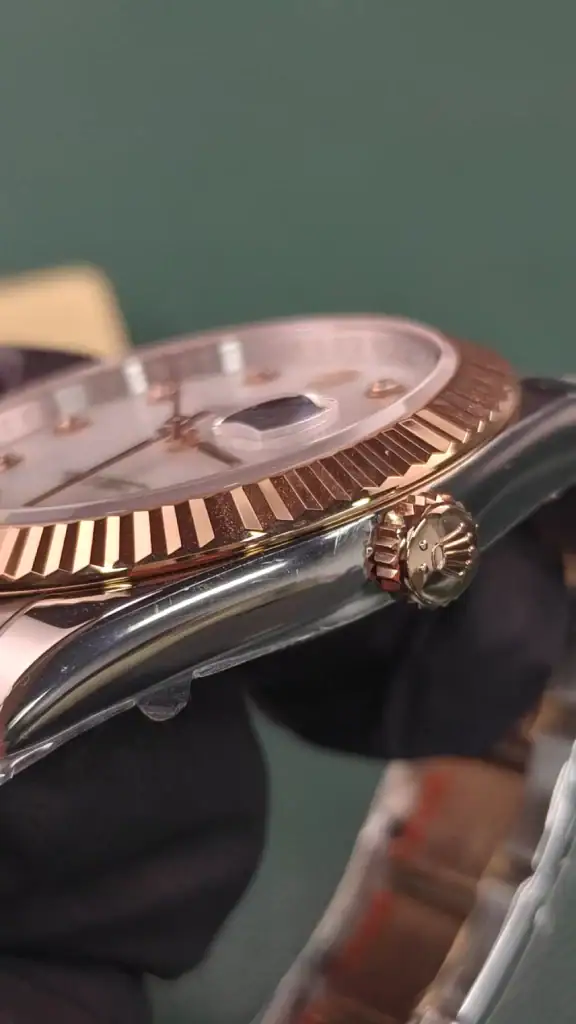
Fluted Bezel Geometry and Light Response
The fluted bezel is not merely ornamental; it functions as a complex optical surface. Each facet responds independently to ambient light, which makes inconsistencies immediately noticeable.
In this 126333 configuration, the bezel facets display uniform edge definition and predictable reflections as the wrist moves. Instead of sharp glare or uneven highlights, the light response appears controlled and continuous. This suggests that attention has been paid to facet geometry and surface finishing rather than relying on aggressive polishing alone.
The result is a bezel that contributes to the watch’s presence without dominating it—a balance that is particularly important in gold-accented designs.



Mother of Pearl Dial: Managing an Organic Variable
Mother of Pearl introduces an element that cannot be fully standardized. Its natural structure creates subtle variations in color and texture, which must be managed rather than eliminated.
In this execution, the dial’s iridescence remains restrained. Color shifts appear gradual rather than abrupt, and the surface maintains visual depth without overwhelming the applied markers. Diamond-set hour indices sit cleanly above the dial plane, preserving legibility while allowing the organic character of the material to remain visible beneath.
This balance is critical. When MOP dials are over-polished or paired with imprecise marker placement, the result often feels visually crowded. Here, spacing and height relationships appear well-judged, supporting clarity in both direct and angled views.
Case Proportions and Wearing Experience
At 41mm, case proportions play a decisive role in how the watch wears across different wrist sizes. The Datejust’s profile favors even mass distribution rather than outright thinness.
On the wrist, the case presents a stable footprint, with the flanks and lugs transitioning smoothly into the bracelet. This continuity contributes to comfort during extended wear, as the watch avoids pressure points that can arise from abrupt geometry changes.
The overall impression is one of balance rather than lightness—appropriate for a two-tone configuration intended to feel substantial without becoming cumbersome.
Movement Behavior in Daily Use
The movement inside the 126333 is best evaluated through behavior rather than specification. In practical terms, winding action feels consistent, crown engagement remains controlled, and time-setting adjustments respond predictably.
Date transitions occur cleanly, and the seconds hand motion remains steady across normal operating conditions. These characteristics reflect an emphasis on stability and repeatability rather than headline performance figures. Over time, such predictability tends to matter more than marginal gains in stated specifications.


Bracelet Integration and Functional Comfort
The Oyster bracelet in a two-tone configuration must balance visual weight with flexibility. In this build, articulation between links feels even, allowing the bracelet to conform naturally to wrist movement.
Gold-toned center links maintain tonal consistency across the bracelet length, while the steel outer links provide structural contrast and durability. Together, they create a cohesive visual rhythm that complements the case rather than competing with it.
Comfort-oriented features, such as fine adjustment capability, further reinforce the watch’s suitability for daily wear rather than occasional display.
Closing Perspective
Two-tone watches often reveal their weaknesses over time rather than at first glance. Uneven wear, mismatched reflections, and inconsistent behavior tend to surface only through regular use. In this respect, the Clean Factory Rolex Datejust 126333 presents a more considered approach.
The interaction between gold and steel remains visually stable, the Mother of Pearl dial adds depth without overwhelming the layout, and the overall structure supports predictable daily operation. These elements work together quietly, without competing for attention.
Rather than aiming to impress through isolated specifications, this execution reflects an understanding of balance—where materials, geometry, and mechanics reinforce one another. For an engineering-focused evaluation, that cohesion ultimately defines the character of the watch.