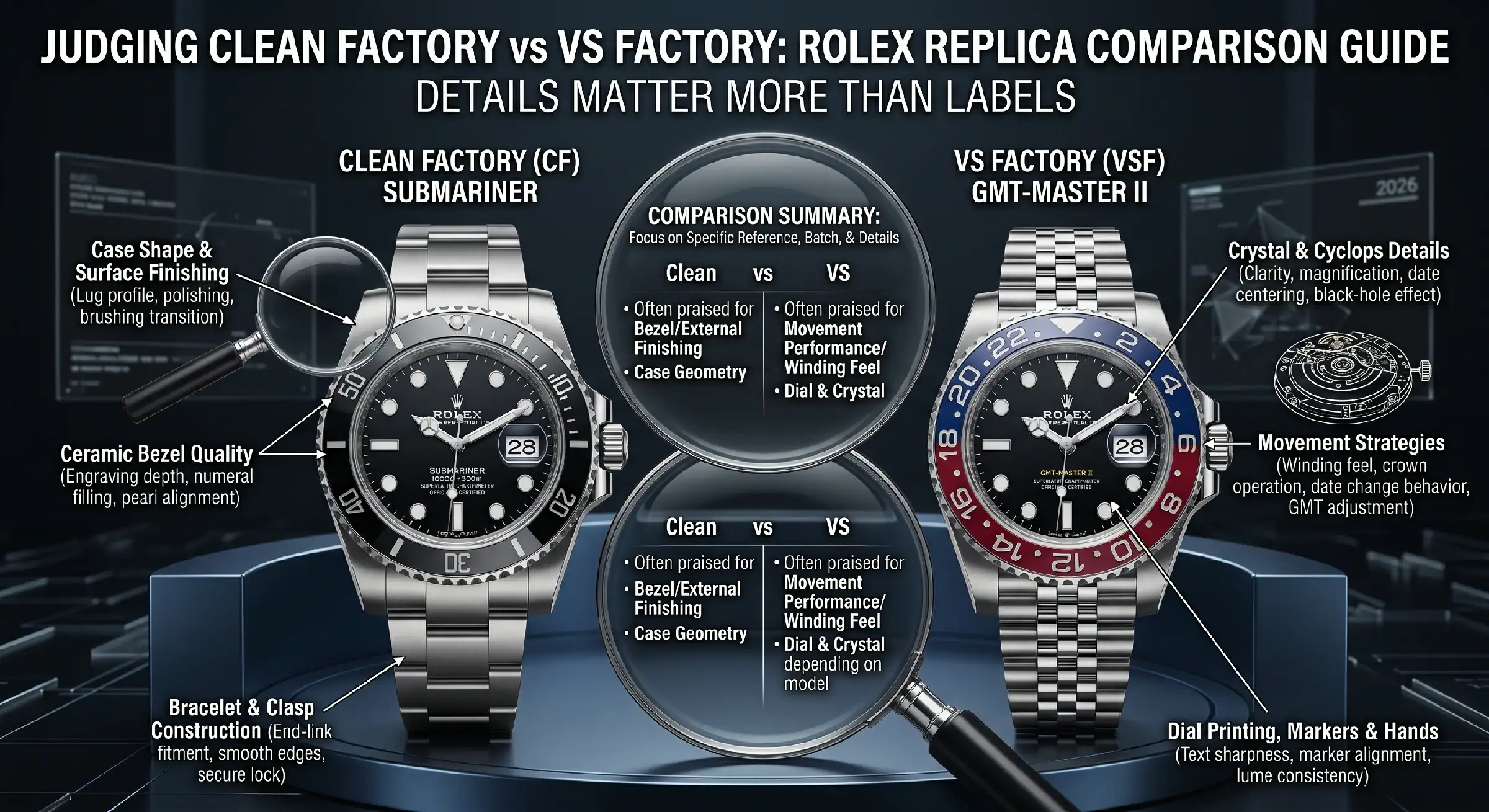
Clean Factory and VS Factory are two names that frequently appear in discussions about high-end Rolex replica watches. They are often compared because both factories have produced well-known versions of popular Rolex-style models, including the Submariner, Datejust, GMT-Master II, and other sports and daily-wear collections.
However, comparing two replica watch factories is not as simple as asking which factory is better.
A factory may perform strongly on one model but show different characteristics on another. External finishing, ceramic bezel quality, dial execution, crystal appearance, bracelet construction, and movement selection can also vary between references and production batches.
This means a useful comparison should focus on specific parts of the watch rather than treating every model from one factory as identical.
In this article, we compare VS Factory and Clean Factory Rolex replicas through several practical areas: case finishing, ceramic bezels, dial and crystal details, bracelet feel, clone movements, and model-specific characteristics.
The purpose is not to select a universal winner. It is to understand why the two factories are often compared and which details should actually be examined when looking at a specific watch.
Why Clean Factory and VS Factory Are Often Compared
The comparison between Clean Factory and VS Factory exists because both are associated with the higher end of the modern replica watch market.
Lower-tier replica watches are often judged mainly by general appearance. From a distance, the dial color and overall case shape may be enough to create a recognizable design. High-end replicas are judged differently.
Closer inspection usually focuses on:
- Case proportions
- Lug shape
- Crown guards
- Ceramic bezel color
- Bezel engraving
- Dial printing
- Marker alignment
- Date window position
- Crystal clarity
- Cyclops appearance
- Bracelet end-link fitment
- Clasp finishing
- Movement operation
Both Clean Factory and VS Factory are regularly examined through these details.
The important point is that the comparison is usually model-specific. A discussion about a Submariner may focus heavily on crystal appearance, movement behavior, and case proportions, while a GMT-Master II comparison may place more attention on bezel color, bracelet construction, and GMT movement operation.
Therefore, factory reputation is only the starting point.
Case Shape and Surface Finishing
The case is one of the most important areas in any Rolex replica comparison.
It is easy to focus on the dial or bezel because these parts are visually obvious, but an inaccurate case can affect the entire character of the watch. Lug thickness, crown guard shape, case side curvature, bezel height, and overall thickness all influence how the watch looks and wears.
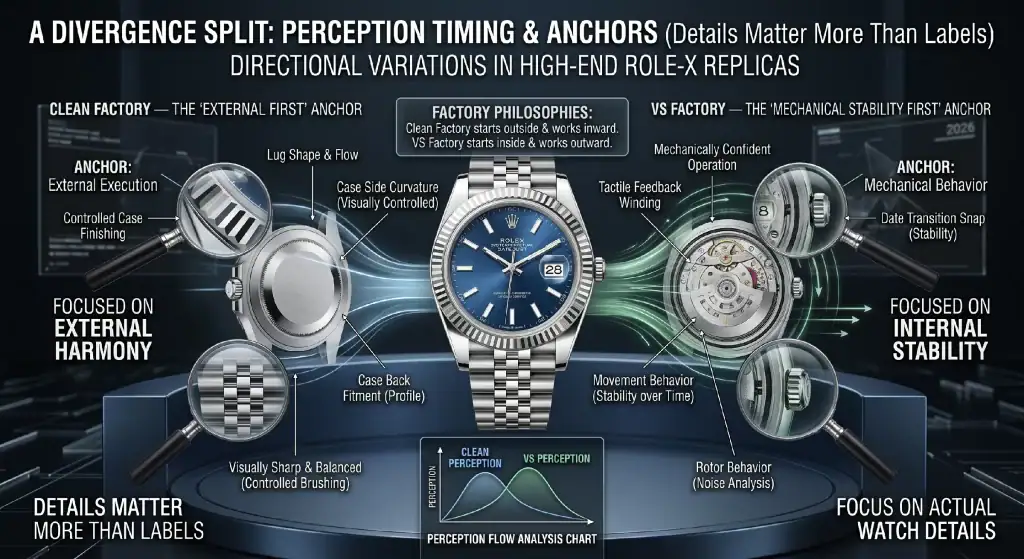
Clean Factory is often associated with careful external finishing. On many of its better-known models, attention is given to the transition between polished and brushed surfaces, case proportions, and the overall shape of the watch.
A good Clean Factory case should show clean brushing on the appropriate upper surfaces and smooth polishing on the sides. The finishing should not appear soft or excessively rounded.
VS Factory watches should be judged using the same standards. Depending on the model, some VS Factory versions are appreciated for a balanced wrist profile and convincing overall proportions.
Rather than asking which factory has the better case in general, inspect:
- Lug width and shape
- Crown guard profile
- Case side curvature
- Thickness from the side
- Bezel seating
- Brushing direction
- Quality of polished surfaces
- Bracelet connection to the case
A Submariner case should feel strong but not unnecessarily bulky. A Datejust should have a more elegant transition between the case and bracelet. These model-specific differences matter more than a general factory ranking.

Ceramic Bezel Quality
Ceramic bezel production is one of the most discussed areas of high-end Rolex replicas.
This is understandable. On models such as the Submariner, GMT-Master II, Daytona, and Yacht-Master, the bezel occupies a large visual area. Small differences in color, engraving depth, numeral filling, or alignment can noticeably change the appearance of the watch.
Clean Factory has developed a strong reputation around ceramic bezel execution, particularly because bezel appearance has been an important part of many of its popular models.
When examining a Clean Factory ceramic bezel, useful QC points include:
- Color tone under natural light
- Engraving depth
- Numeral filling
- Alignment at 12 o’clock
- Surface finish
- Edge quality
- Bezel insert seating
On a Submariner, the pearl position is another important point. On a GMT-Master II, the transition between the two bezel colors becomes more significant.
VS Factory ceramic bezels should be judged in the same way. A factory name alone cannot tell the complete story because different colors are technically different challenges.
For example, a black ceramic bezel is relatively straightforward compared with a two-color GMT bezel. Pepsi-style red and blue, Batman-style blue and black, and Sprite-style green and black all create different visual challenges.
The most useful comparison is therefore not:
“Which factory makes the best ceramic bezel?”
A better question is:
“How does this specific bezel color and reference compare between the available versions?”
That narrower question usually leads to a more accurate evaluation.
Dial Printing, Markers and Hands
The dial is another area where general factory comparisons can become misleading.
A simple black Submariner dial and a textured Datejust dial require different production techniques. A Daytona dial introduces sub-dials, chronograph hands, multiple printing areas, and more opportunities for alignment problems.
When examining Clean Factory or VS Factory dials, focus on:
- Text sharpness
- Logo position
- Marker alignment
- Minute track consistency
- Hand finishing
- Lume color
- Dial texture
- Dust under the crystal
Clean Factory versions are often discussed for strong external presentation, but dial quality still needs to be checked model by model.
The same is true for VS Factory. Some buyers focus too heavily on factory reputation and forget that an individual piece can still have a slightly misaligned marker, dust, or inconsistent hand position.
For chronograph models, the reset position of the central chronograph hand should also be checked. For Datejust models, dial texture and light reflection can matter more than they do on a simple sports watch.
The dial should therefore be inspected as part of the complete watch, not separately from the case, bezel, crystal, and hands.
Crystal and Cyclops Differences
Crystal appearance can change the visual character of a Rolex replica more than many buyers expect.
Even when the dial itself is well executed, differences in transparency, reflections, cyclops position, and date magnification can affect the entire front view of the watch.
When comparing Clean Factory and VS Factory versions of a date model, inspect:
- Crystal clarity
- Surface reflections
- Cyclops position
- Date magnification
- Distortion around the date window
- Black-hole-style visual effect around the date, where relevant
This area is especially important for models such as the Submariner Date, Datejust, and GMT-Master II.
There is no useful reason to declare that one factory always has a superior crystal across every model and every production period. The better approach is to compare the exact references being considered.
A crystal can also be changed independently, which is another reason it should not be treated as the only factor when judging an entire watch.
Bracelet and Clasp Construction
The bracelet is where visual quality becomes physical experience.
A watch may look convincing in photos, but the bracelet can immediately reveal whether the overall construction feels refined or basic.
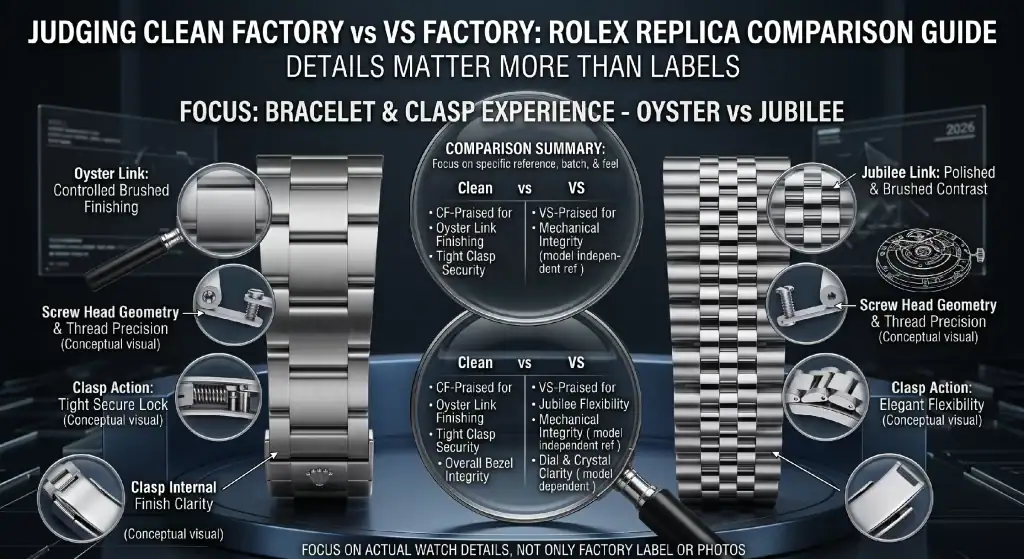
Clean Factory bracelets are often examined for:
- Solid end-link fitment
- Brushing quality
- Polished center-link finish where applicable
- Edge smoothness
- Screw quality
- Clasp action
- Bracelet taper
VS Factory bracelets should be evaluated using the same points.
The Oyster bracelet and Jubilee bracelet should not be judged in exactly the same way.
An Oyster bracelet should feel solid and stable. A Jubilee bracelet needs more flexibility because of its multi-link structure, but it should not feel excessively loose.
The clasp is equally important. Check whether it opens and closes cleanly, whether the locking system feels secure, and whether the internal finishing is reasonably clean.
One of the biggest mistakes in factory comparisons is focusing only on photographs. Bracelet quality needs to be felt on the wrist.
Movement Strategy: Why the Comparison Becomes More Complicated
Movement comparisons are probably the most misunderstood part of Clean Factory vs VS Factory discussions.
People often see movement names such as:
- 3235-style clone movement
- 3285-style clone movement
- 4130-style chronograph movement
- 4131-style chronograph movement
and assume that the movement name alone determines the quality of the entire watch.
It does not.
Movement performance should be evaluated through:
- Winding feel
- Crown operation
- Hand-setting behavior
- Date change
- Power reserve
- Rotor noise
- GMT hand operation
- Chronograph start, stop, and reset
- Timekeeping stability
Clean Factory and VS Factory do not necessarily follow exactly the same movement strategy across every model.
In some comparisons, buyers may prefer the external execution of one version while paying more attention to movement behavior in another. This is why the correct comparison depends on the reference.
For example, the questions for a Submariner should include:
Does the date change correctly?
How does the crown feel during winding and setting?
Is the rotor unusually noisy?
How stable is the watch after several days?
For a GMT-Master II, another question appears:
How does the GMT hand adjustment work?
For a Daytona, chronograph operation becomes more important:
Does the chronograph start cleanly?
Do the hands reset correctly?
Are the pushers consistent?
These practical observations are more useful than simply repeating the movement name.
Comparing Different Model Categories
The following overview shows why a factory-level comparison should remain flexible:
| Category | Common Clean Factory Discussion Points | Common VS Factory Discussion Points |
|---|---|---|
| Submariner | Case finishing, ceramic bezel, bracelet construction | Movement behavior, crystal appearance, overall daily use |
| GMT-Master II | Ceramic bezel, case profile, bracelet and clasp | Movement operation and model-specific external details |
| Datejust | Dial execution, bezel appearance, bracelet combination | Movement behavior, dial and crystal depending on version |
| Daytona | Case, bezel, dial layout, chronograph appearance | Model-dependent comparisons and movement considerations |
This table is not a ranking.
It only shows that different watches create different comparison priorities.
A buyer evaluating a Datejust should not use exactly the same criteria as someone comparing a GMT-Master II. The design and mechanical functions are different.
External Accuracy vs Daily Mechanical Experience
One useful way to understand the Clean Factory vs VS Factory discussion is to separate two broad areas:
External execution includes:
- Case
- Bezel
- Dial
- Crystal
- Bracelet
- Clasp
Mechanical experience includes:
- Winding
- Setting
- Date operation
- GMT adjustment
- Chronograph function
- Rotor behavior
- Power reserve
A strong watch needs both areas to work together.
An attractive bezel cannot compensate for a badly operating movement. At the same time, a stable movement does not automatically correct an inaccurate case or weak dial.
This is why comparing complete watches is more useful than comparing factory names.
Why Batch and Individual QC Still Matter
Even after comparing factory characteristics, there is another important point: the individual watch still matters.
Replica watch production is not perfectly identical across every piece. Minor differences can exist between:
- Production periods
- Batches
- Dial suppliers
- Bracelet components
- Movement adjustments
- Individual assembly quality
This is why QC remains necessary even when buying from a well-known factory.
Two watches from the same factory and the same reference can still show small differences in:
- Bezel alignment
- Date centering
- Dial marker position
- Rehaut alignment
- Clasp feel
- Chronograph reset
- Rotor noise
Factory comparison is useful for understanding general characteristics. QC is necessary for judging the actual watch.
A Practical Comparison Method
Instead of starting with the question, “Clean Factory or VS Factory?” try this process.
First, identify the exact reference.
A general comparison of two factories is less useful than comparing two specific versions of the same model.
Second, divide the watch into sections:
- Case and proportions
- Bezel
- Dial and hands
- Crystal and date
- Bracelet and clasp
- Movement operation
Third, determine which differences are actually important to that model.
For example, on a GMT watch, movement operation and bezel color may be high priorities. On a Datejust, dial finishing, bezel appearance, and bracelet feel may be more visually important.
Finally, look at QC for the individual watch.
This approach creates a more realistic comparison than choosing entirely by factory reputation.
So, Is Clean Factory Better Than VS Factory?
There is no accurate universal answer.
That may sound less exciting than declaring a winner, but it is the more realistic conclusion.
Clean Factory and VS Factory have both become well known because they have produced models with different strengths. The result depends on:
- The exact Rolex reference
- The specific version
- The production period
- The movement used
- The quality of the individual piece
- The details the buyer personally notices most
For one model, external finishing may be the main reason a version receives attention. For another model, movement operation may become a larger part of the discussion.
A factory name is useful information, but it should not replace actual inspection.
Final Thoughts
The Clean Factory vs VS Factory comparison is useful only when it goes beyond simple statements about which factory is “best.”
A better comparison looks at the watch piece by piece.
Check the case shape. Look at the ceramic bezel under different lighting. Examine dial printing and marker alignment. Inspect the crystal and date magnification. Feel the bracelet and clasp. Test the crown and movement functions.
These observations provide more useful information than factory reputation alone.
Clean Factory is often associated with strong external execution and ceramic bezel quality on many of its popular models. VS Factory is frequently discussed in relation to movement performance and specific model configurations. However, neither description should be applied blindly to every watch.
The most accurate conclusion is simple: compare the exact model, understand the strengths of each version, and inspect the individual watch.
In the high-end Rolex replica market, details matter more than labels.