If you observe the luxury watch market in 2026, a fascinating economic paradox emerges. While the grey market premiums for genuine luxury timepieces have experienced significant volatility, the demand for top-tier “Super Clones” has exploded, reaching historic highs among high-net-worth collectors.
Why? Because the replica watch industry has quietly undergone an industrial revolution. Leading this charge is Clean Factory (CF).
To understand why a Clean Factory Daytona or Datejust commands such respect, you must abandon the outdated idea of a single, dimly lit workshop churning out fake watches. In reality, Clean Factory operates much like Apple Inc.—they are master integrators. They have orchestrated a highly specialized, horizontally integrated supply chain, uniting the absolute best micro-manufacturers in China into an unstoppable “Super Alliance.” Today, we are pulling back the curtain on how this ecosystem operates.
Table of Contents
Toggle1. The Cerachrom Monopoly: Where It All Began
Before Clean Factory was producing complete watches, they were famous in the modding community solely for their bezels.
Historically, replicating the Rolex Cerachrom ceramic bezel was the Achilles’ heel of the clone industry. Competitors struggled with fading colors, off-white numbering, and brittle materials. Clean Factory invested heavily in high-temperature ceramic firing and mastered the exclusive vacuum plating process required to inject real platinum into the tachymeter and dive scale engravings.
To this day, CF maintains a strict monopoly on this specific bezel technology. Their green “Hulk” (116610LV) and blue/red “Pepsi” (126710BLRO) ceramic inserts are so accurate that they are frequently purchased on the black market by unscrupulous dealers to create “Franken-watches” using genuine cases. This bezel mastery remains the unbreakable foundation of the CF empire.
2. The ARF Partnership: Mastering 904L Oystereel
A watch’s tactile feel—that crucial “heft” and silky drape on the wrist—is dictated entirely by its metallurgy and machining. Instead of attempting to mill their own steel, Clean Factory made a brilliant strategic alliance: they secured the primary output of the AR Factory (ARF) bracelet supply chain.
Within horological circles, ARF is legendary for its uncompromising processing of 904L stainless steel. 904L is a notoriously difficult superalloy to machine due to its high nickel and molybdenum content. By utilizing ARF’s CNC facilities, Clean Factory ensures their Oyster and Jubilee bracelets possess exact genuine tolerances. The chamfered edges, the mirror-polished center links, and the crisp mechanical snap of the Glidelock and Easylink clasps are indistinguishable from Swiss manufacturing. CF essentially outsourced their steelwork to the undisputed master of the craft.
3. The Dandong Pact: The Mechanical Heartbeat
For years, the movement was where clones failed the ultimate test. They were loud, unreliable, and lacked power reserve.
Clean Factory shattered this barrier by forming strategic, priority-access agreements with the Dandong Movement Factory. Dandong is responsible for the true 1:1 clone architectures, most notably the DD4130/DD4131 (for the Daytona) and the latest 27-jewel DD3235 (for the Datejust and Submariner).
By securing the newest batches of these engines, CF guarantees their watches feature genuine 70+ hour power reserves, functional vertical clutches, and remarkably quiet rotors. This specific alliance officially leveled the playing field, completely neutralizing the mechanical advantage once held exclusively by competitors like VS Factory.
4. The Optics Syndicate: Sapphire and Dial Printing
A perfect case and movement mean nothing if the dial looks flat behind cloudy glass.
- The Sapphire: Clean Factory sources high-transmittance sapphire crystals treated with double-layer, edge-to-edge Anti-Reflective (AR) coatings, specifically focusing on the cyclops magnification window to recreate the famous “black hole” effect.
- The Dial: The micro-printing on CF dials—such as the 3D relief on the red “DAYTONA” text or the precise sunburst graining on their blue dials—is contracted to specialized dial makers who utilize high-resolution pad printing. Furthermore, they source luminescent materials that perfectly match the specific blue-green wavelength and decay rate of Rolex’s Chromalight.
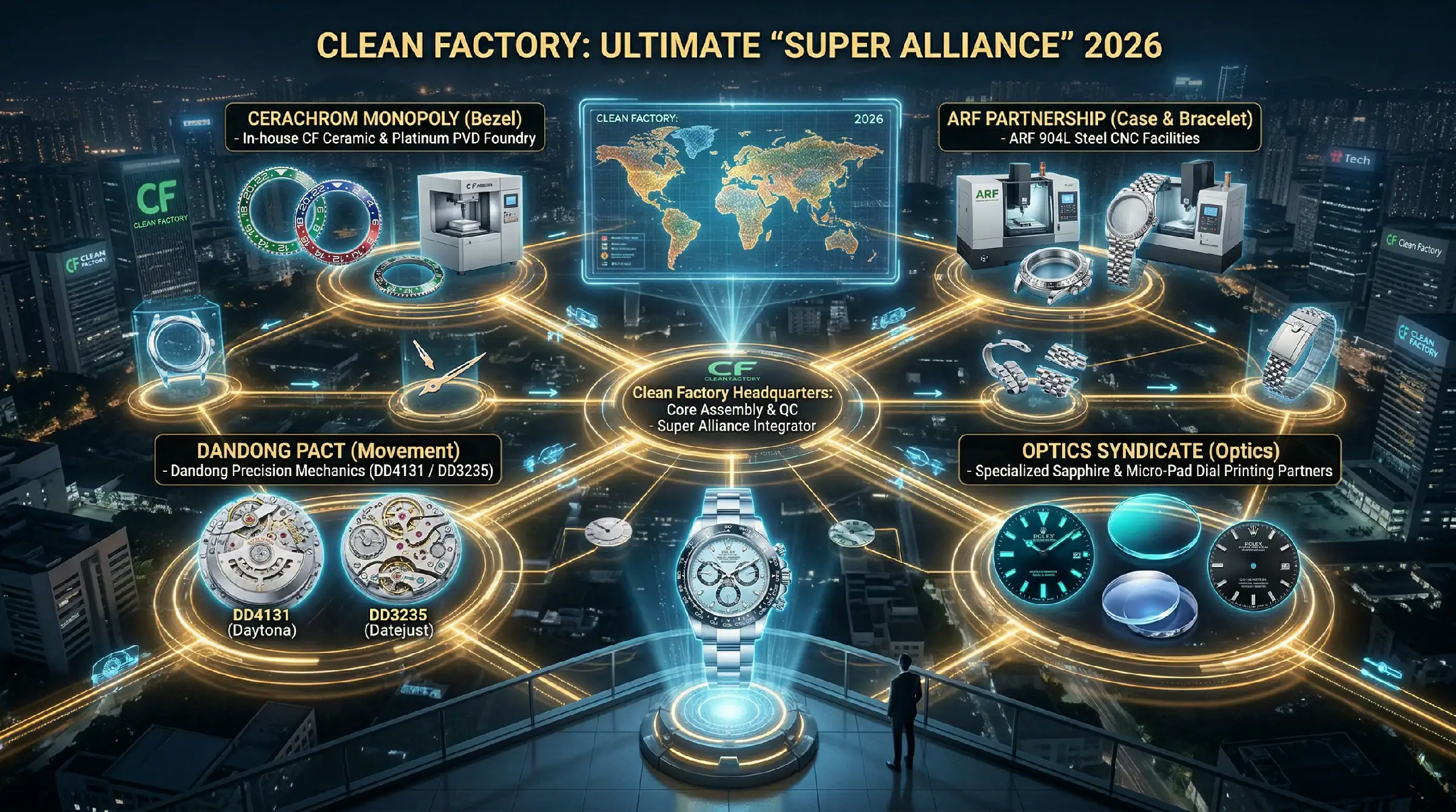
⚙️ The Clean Factory 2026 Ecosystem Map
A visualization of the decentralized Super Clone manufacturing network.
🔸 Core Assembly & QC: Clean Factory Headquarters ├──
🔹 Bezel: In-house CF Ceramic & Platinum PVD Foundry ├──
🔹 Case & Bracelet: ARF 904L Steel CNC Facilities ├──
🔹 Movement: Dandong Precision Mechanics (DD3235 / DD4131) ├──
🔹 Optics: Specialized Sapphire & Micro-Pad Dial Printing Partners├──
The Final Verdict: Integration is the Ultimate Luxury
When you purchase a Clean Factory timepiece in 2026, you are not buying a product from a single assembly line. You are buying the culmination of a vast, highly specialized industrial syndicate.
By acting as the ultimate quality controller and integrator, Clean Factory has eliminated the historical compromises of replica collecting. They have proven that when you combine the best ceramic, the best steel, and the best mechanical clones under one unified brand, the result is a timepiece that easily crosses the “uncanny valley,” satisfying even the most discerning horological purists.
FAQ
This is where CF’s true value lies: Final Quality Control (QC) and assembly. While the components are manufactured by specialized micro-factories, the final casing, dial alignment, hand setting, and waterproofing are handled centrally by Clean Factory’s in-house master watchmakers. This strict centralized QC guarantees that a Dandong movement and an ARF bracelet merge flawlessly.
The “Super Alliance” supply chain is highly vulnerable to bottlenecks. If AR Factory faces a delay in 904L steel processing, or if Dandong restricts the supply of the 4131 movement batch to maintain quality, Clean Factory will halt production rather than use inferior backup parts. This adherence to quality over sheer volume causes periodic market shortages.
Yes. Other top-tier manufacturers frequently attempt to source from the same suppliers (for example, attempting to buy Dandong movements). However, Clean Factory’s massive purchasing power and long-standing contracts often grant them priority access or exclusive rights to the best and latest batches of components, maintaining their competitive moat.
Officially, no. Clean Factory restricts the distribution of its raw components to protect its fully assembled watch market. However, a highly lucrative grey market exists within the modding community where CF bezels or ARF bracelets are harvested from complete watches and sold individually for premium prices.