
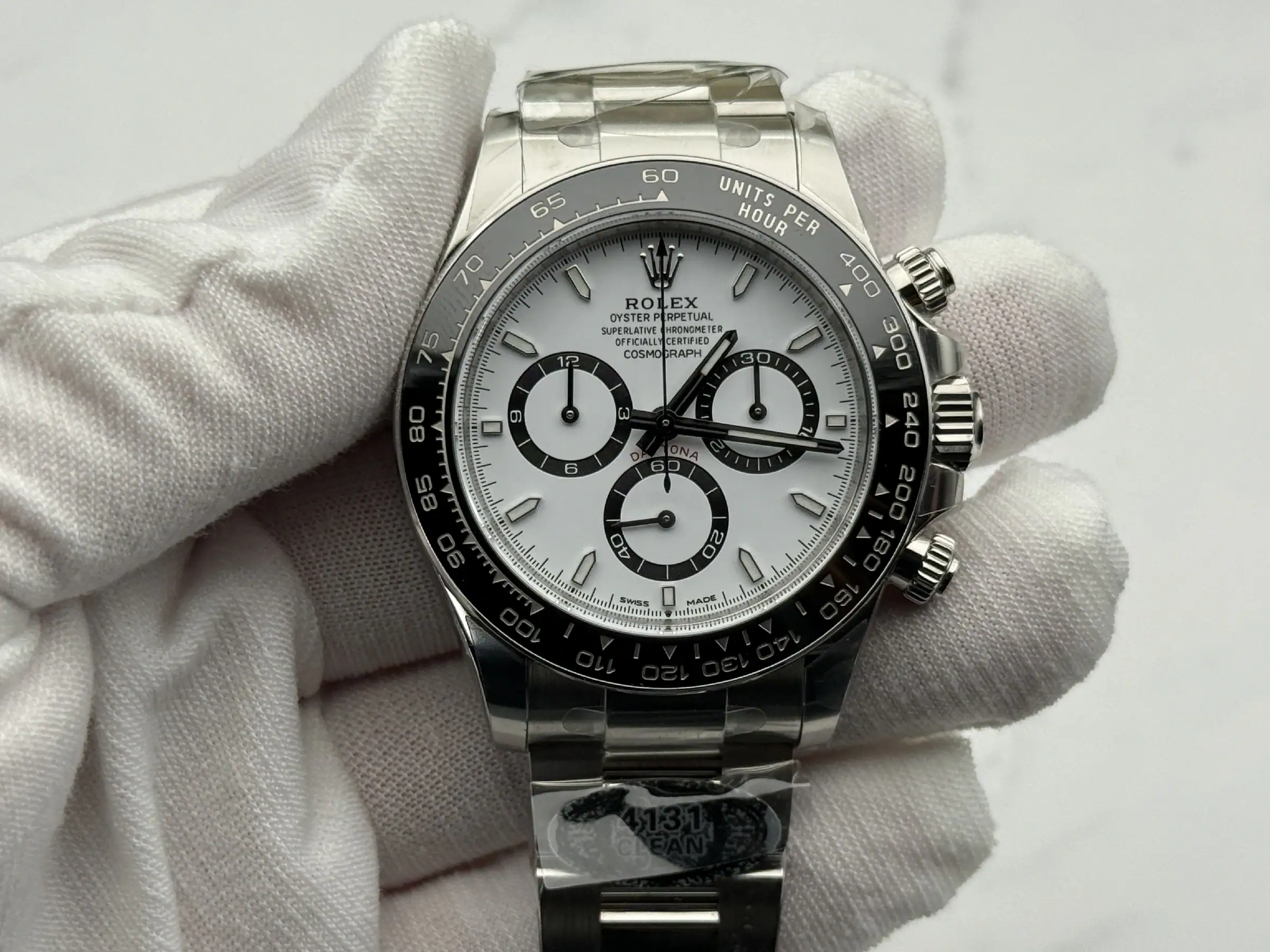
Among modern replica chronographs, the Clean Factory Rolex Daytona 126500LN is one of the few models that gets discussed not just as another copy, but as a serious attempt at recreating one of Rolex’s most recognizable sports watches in current production.
That also makes it harder to judge fairly. A watch like this cannot rely on novelty or unusual color to distract the eye. The white Panda dial, black ceramic bezel, compact 40mm case, and updated 4131-style layout are already too familiar to collectors. People know what the genuine watch is supposed to look like, which means the Clean Factory version has to succeed through proportion, finishing, and overall completeness rather than through any single headline feature.
This review looks at the watch from exactly that angle. Not as a genuine Daytona, and not as a product-page pitch, but as a high-end replica with its own strengths, its own limitations, and a level of execution that deserves to be judged on how close it really gets.
Why the Clean Factory version faces more scrutiny than most
The Daytona has always occupied a slightly unusual place in the Rolex world. Technically, it is a chronograph with roots in motorsport. Culturally, it has become something much larger than that. It carries status, instant recognition, long waiting lists, strong resale gravity, and a kind of visual fame that very few modern watches can match.
That is exactly why the 126500LN is such a difficult watch to replicate well. A Submariner can sometimes benefit from sheer familiarity. A GMT-Master II can distract the eye with color. The white-dial ceramic Daytona does not really get that luxury. It is too well known, too heavily photographed, and too often discussed in terms of tiny details.
When Rolex moved from the 116500LN to the 126500LN generation, the change was subtle rather than dramatic. At a glance, the design language remained the same. But collectors quickly noticed that the case, dial, bezel relationship, and general proportions had been refined. The movement generation also changed, which added another layer of discussion even if most people would never see the movement itself in daily use.
That creates a very particular challenge for a replica factory. It is not enough to make something that generally resembles a Daytona. It has to resemble the current Daytona, and it has to do so without overcompensating. On a watch like this, being slightly too thick, slightly too bright, or slightly too aggressive in one area can upset the whole balance.
In that sense, the Clean Factory 126500LN is being judged against a very demanding standard. The question is not whether it looks impressive in isolation. The real question is whether it captures the calm, tightly controlled feel of the genuine watch closely enough that the overall impression holds together.
First impressions: where this watch starts strong
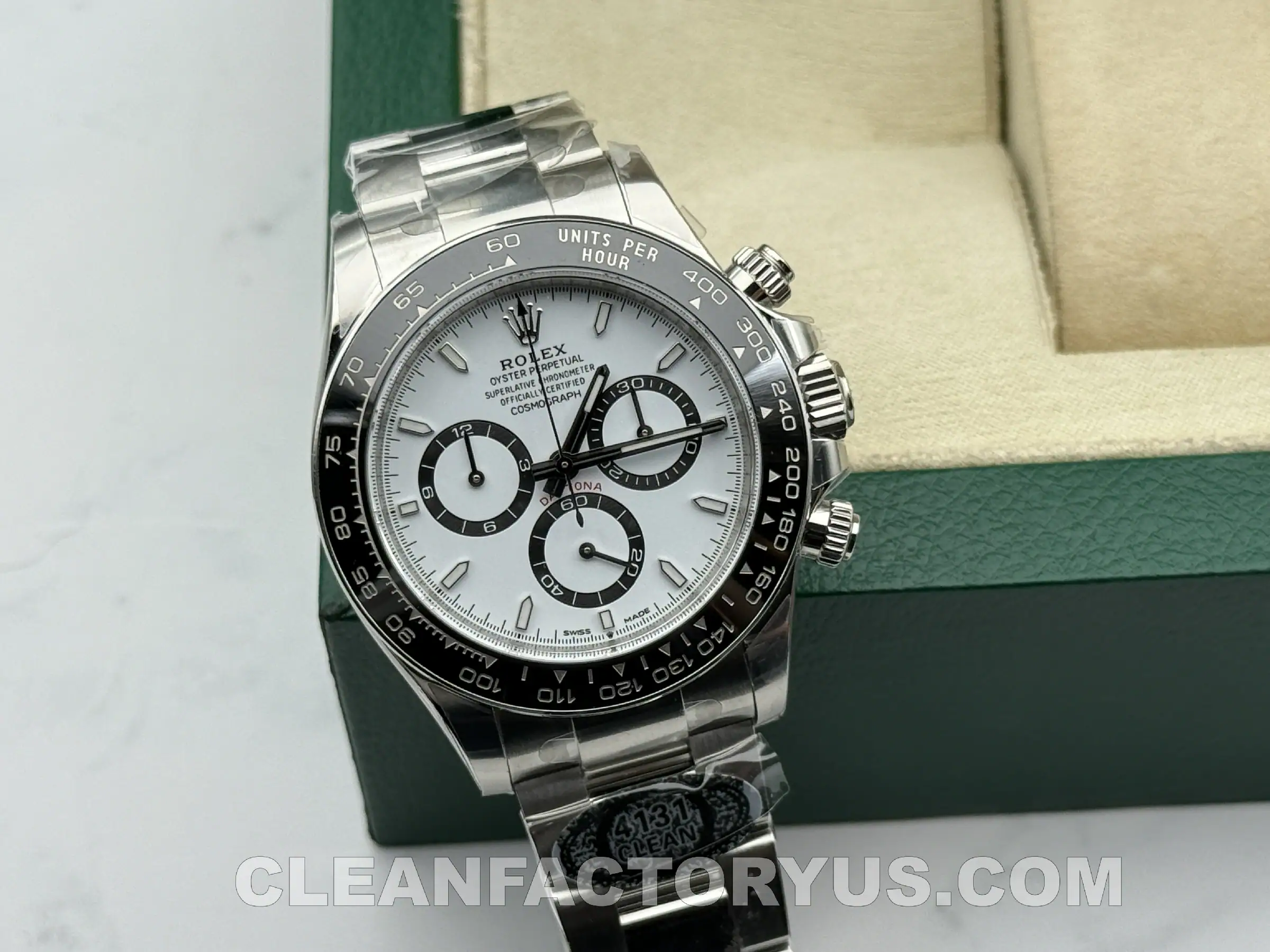
Some watches grow on you over time. The Daytona usually works faster than that. The white Panda configuration has a kind of immediate clarity that tends to register almost instantly, and this version benefits from that same quality.
The first thing that stands out is cohesion. The black ceramic bezel frames the dial sharply. The white dial gives the subdials room to breathe. The steel case and bracelet keep the watch grounded so that it still feels like a sports chronograph rather than a decorative object. There is contrast, but it does not feel theatrical. That balance is what gives the Panda Daytona its staying power, and Clean Factory seems to understand that clearly.
What makes the watch convincing at a glance is not really one single hero feature. It is the fact that nothing immediately jumps out in the wrong way. The bezel does not feel oversized. The dial does not look busy. The case does not appear swollen. That may sound like modest praise, but with a watch this well known, avoiding obvious weakness matters more than trying to overwhelm the viewer with one dramatic detail.
On the wrist, the 40mm size still feels very close to ideal for a Daytona-style chronograph. The watch wears smaller than many modern sports pieces, but it does not feel slight. Instead, it feels controlled and deliberate. That has always been part of the Daytona’s appeal, and this version retains enough of that compact density to make the wearing experience feel familiar.
Case proportions: where Clean Factory gets the 126500LN mostly right
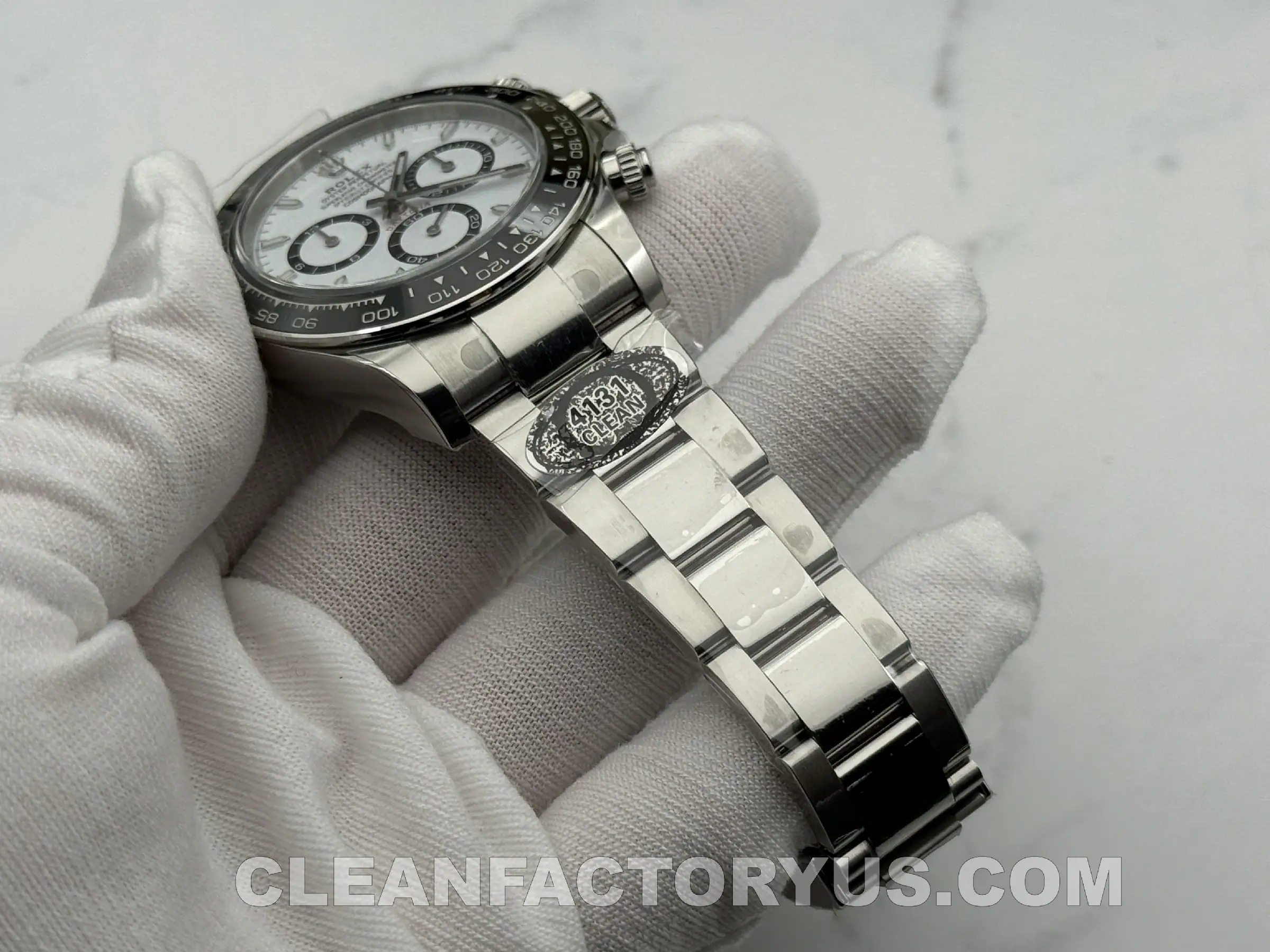
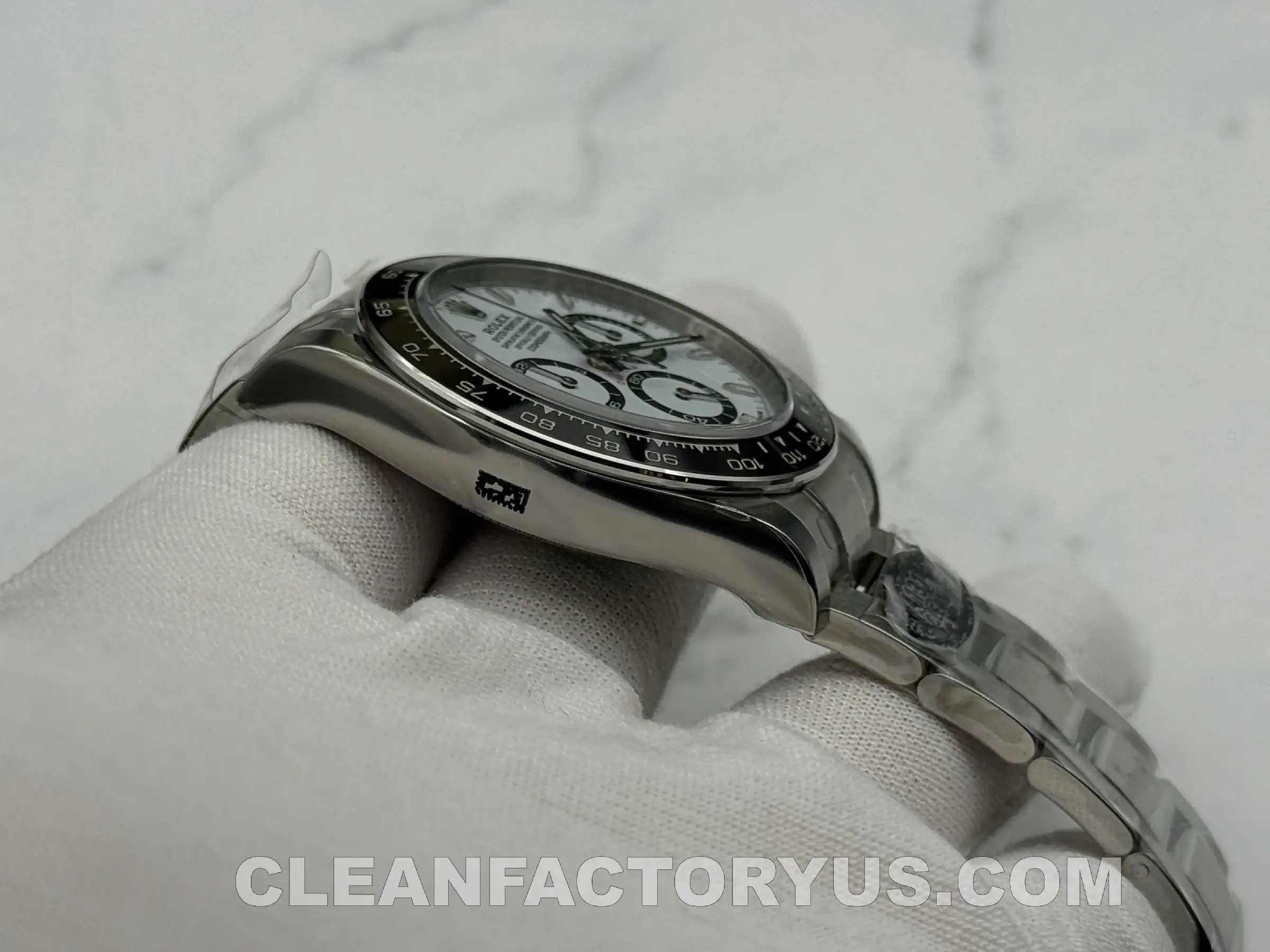
The case is one of the most important parts of this watch, because the Daytona is not a design that forgives clumsy execution. Its appeal comes from proportion more than raw size. The lugs, bezel, pushers, crown guards, and case flank all need to feel like they belong to the same drawing.
That is why case shape matters so much here. If the mid-case is too thick, if the lugs feel too blunt, or if the side profile becomes too heavy, the watch starts losing the very restraint that makes a Daytona attractive in the first place.
On this model, Clean Factory does a solid job with that balance. The case feels modern without becoming blocky. The lugs have enough definition to hold the shape properly, and the polished case sides catch light the way they should without making the watch look soft. The pushers and crown also sit comfortably in the side profile rather than crowding it.
This is one of those areas where direct comparison with the genuine watch can still reveal small differences, especially under unforgiving lighting or macro photography. That is true of almost any replica at this level. But from normal viewing distance, the broader geometry is handled well enough that the watch preserves the right stance.
More importantly, it does not feel like a watch trying too hard to look substantial. Some weaker Daytona replicas end up looking bulky because thickness is used as a shortcut for presence. That approach usually backfires. Here, the watch feels measured instead. It wears with enough authority to feel premium, but not so much that it becomes awkward.
Dial and bezel balance compared with the genuine watch
The 126500LN is one of those references where the relationship between dial and bezel matters almost as much as the individual parts themselves. A good Panda Daytona does not depend on a spectacular bezel alone or a dramatic dial alone. It works because both elements feel correctly weighted.
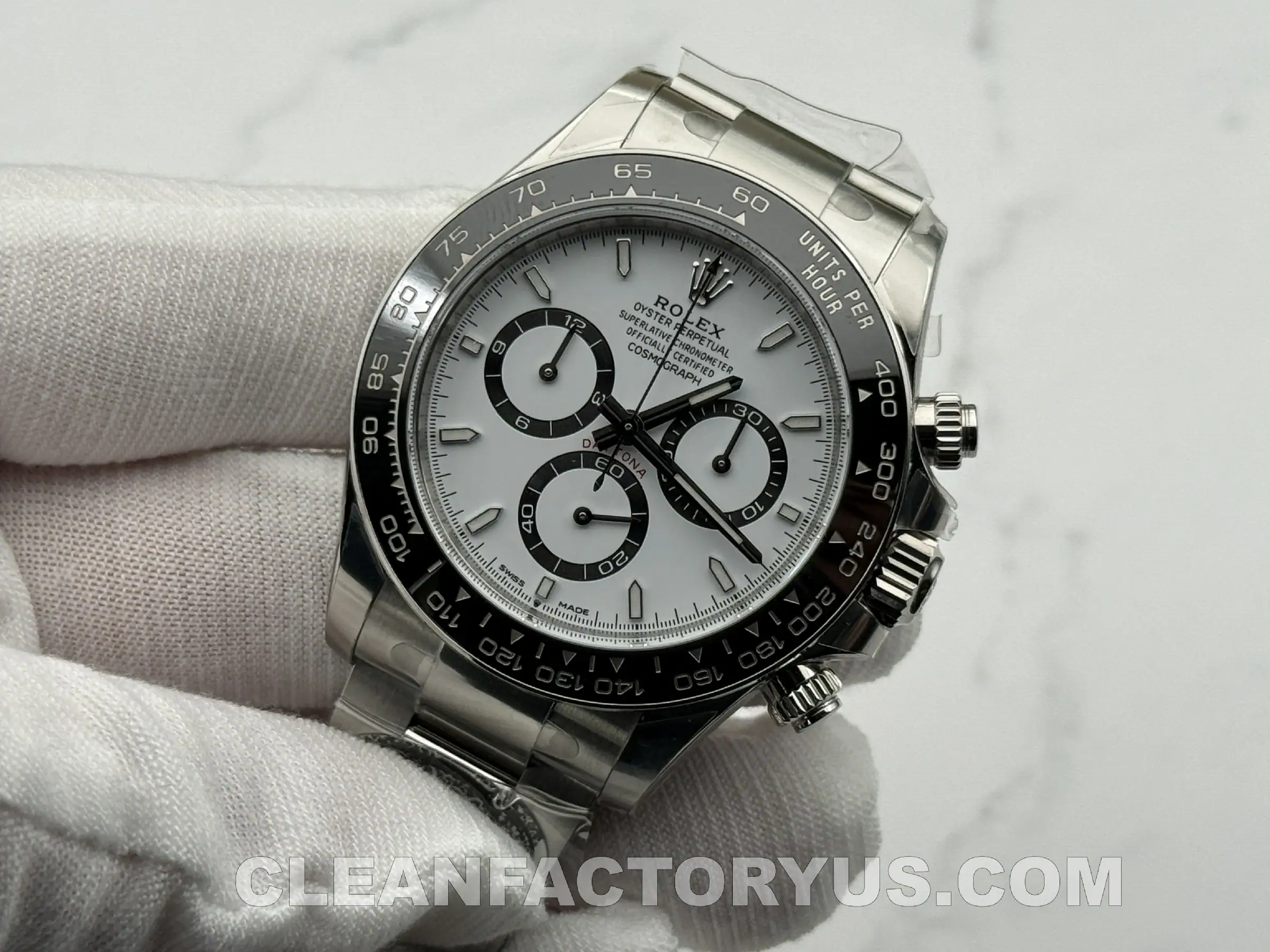
The black ceramic bezel on this watch is one of its more convincing parts. The gloss level looks controlled rather than glassy, and the tachymeter text feels integrated rather than overemphasized. The insert frames the dial instead of shrinking it, which is important because the modern Daytona still needs breathing room on the face.
The white dial also helps the watch quite a bit. A weak white dial can look chalky, cold, or flat. A better one feels clean and bright without turning sterile. This dial sits in the second category. The black-ringed subdials create enough tension and contrast to keep the face lively, while the applied markers and central hands stay visually disciplined.
Placed next to the genuine 126500LN, the differences are still there if you know where to look. The genuine piece has a slightly more settled sense of precision in the smallest details, especially in the way the dial furniture, bezel text, and overall finishing come together under very close inspection. The original also tends to have that last bit of visual ease that is difficult to replicate fully.
But the gap is no longer in the broad identity of the watch. From normal viewing distance, the Clean Factory version captures most of what people respond to in the modern white-dial Daytona: the contrast, the ceramic framing, the compact case, and the calm visual tension that makes the design work in the first place.
That is what gives this watch its credibility. It may not erase the difference, but it narrows it in the areas most people actually notice.
The white Panda dial: more difficult than it looks
A white Daytona dial sounds simple until you spend time with enough examples. Then it becomes obvious how easy it is for things to go slightly wrong. The tone of the white surface, the weight of the printed text, the crispness of the subdials, and the sense of spacing across the face all contribute to whether the watch feels alive or slightly off.
This dial does a lot of things correctly by not overdoing them. The white surface looks clean without appearing stark. The black subdial rings create structure, but the watch does not become too graphic or aggressive. The markers sit naturally, and the overall face remains easy to read.
One of the more important qualities here is that the dial still feels calm. That may sound vague, but it matters. The Daytona can become visually nervous very quickly if the printing is too bold, the subdials feel too flat, or the hands start competing with the markers. This version avoids that problem. It keeps enough composure that the face reads as a single design rather than a collection of elements fighting for attention.
Under magnification, there will always be details that invite debate. That is inevitable on a watch this famous. But in daily wear, the dial succeeds because it preserves the right kind of clarity. It looks clean, modern, and properly proportioned, which is exactly what a Panda Daytona needs.
How complete does the Clean Factory finishing feel on the wrist?
One of the more useful ways to judge a watch like this is not to ask whether it looks perfect under magnification, but whether the overall execution feels complete.
That is where the Clean Factory version does well. The case, bezel, dial, and bracelet do not feel like separate strengths pulled from different projects. They feel integrated, which is often the difference between a replica that photographs well and one that actually wears convincingly.
This is especially noticeable on the wrist. Some replicas can impress in static photos and then lose coherence once worn because the case sits awkwardly, the bracelet drapes poorly, or the dial and bezel do not carry the same level of finish. Here, that mismatch is largely avoided. The watch feels resolved as a whole, which is not always easy to achieve on a Daytona.
Compared with the genuine 126500LN, the remaining differences are still present in the finer finishing nuances and the mechanical architecture beneath the surface. But as a complete object, this version feels more thought through than many replicas that may get one visible area right while leaving another noticeably behind.
In other words, the appeal here is not just accuracy in isolated parts. It is the sense that the build has been finished with a consistent standard across the watch.
Crystal, rehaut, and the details people notice later
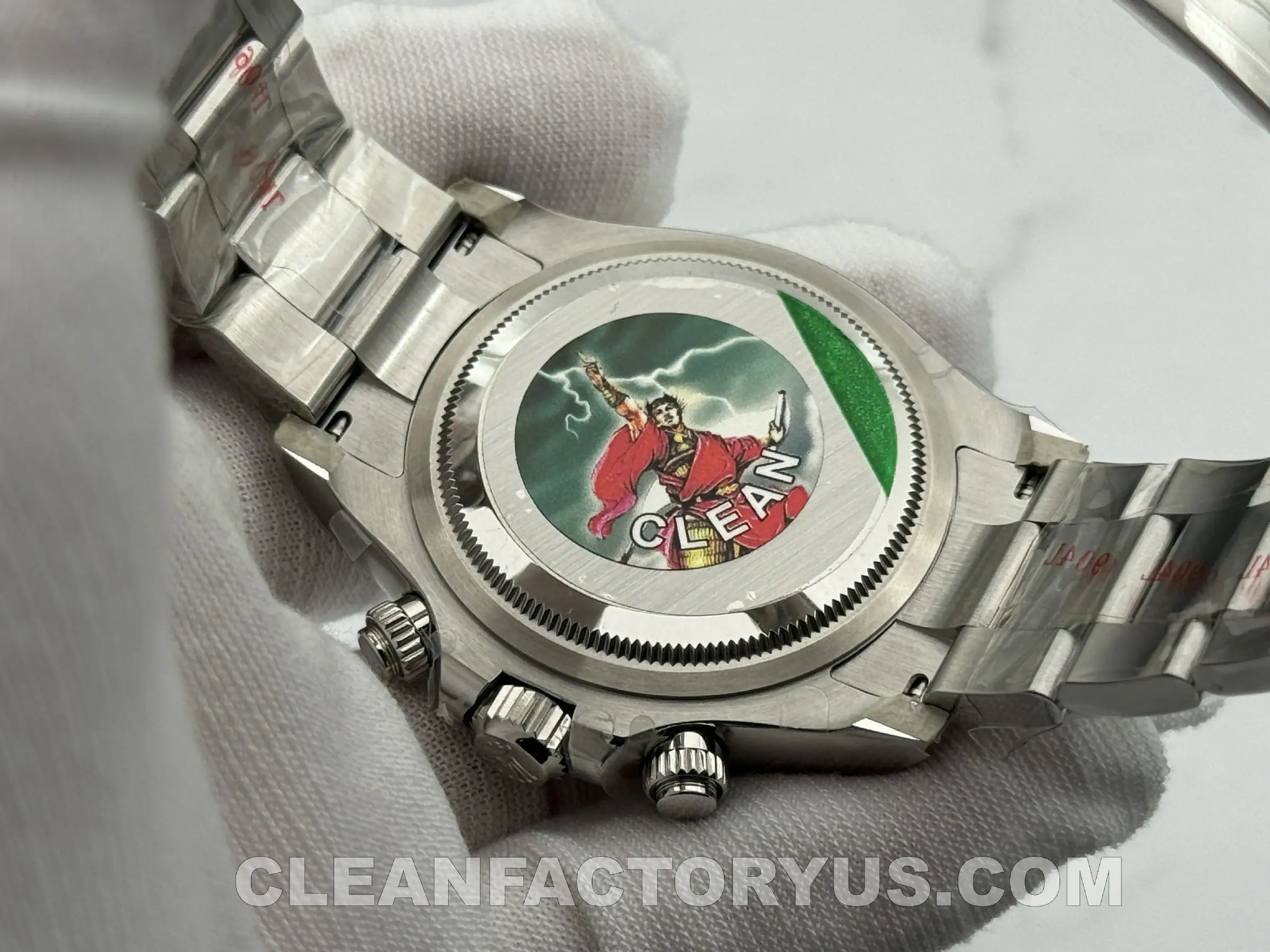
On a watch like this, some details only start to matter after the first few wears. Crystal clarity, rehaut alignment, edge behavior, and subdial depth are all part of that second layer of judgment. These are not the things that grab attention immediately, but they often decide whether the watch continues to feel convincing once the novelty wears off.
The crystal on this model stays out of the way, which is the best thing it can do. The white dial depends on visual sharpness, so any haze, distortion, or awkward reflection would become noticeable quickly. Here, the dial remains clear and well presented from normal angles.
The rehaut is tidy enough that it supports the overall order of the watch rather than distracting from it. This is not an area most people obsess over in daily wear, but if it is visibly messy, the watch tends to feel unfinished. Clean Factory has done enough here that the watch retains a sense of precision when viewed up close.
Subdial depth also contributes to that feeling. The subdials do not look pasted onto a flat surface. They have enough dimensional separation to give the face structure without becoming exaggerated.
These details are not the reason someone buys the watch, but they are part of the reason the watch continues to feel credible after the first impression has passed.
Bracelet and clasp: the part that determines daily comfort
The bracelet is where many watches quietly succeed or fail. You can admire a dial in photos, but the bracelet is what you actually live with. On a Daytona, that matters even more because the watch itself is relatively compact. If the bracelet feels hollow, stiff, or disconnected from the case, the whole experience loses credibility quickly.
This bracelet feels reassuring without becoming overbuilt. The brushing is clean, the polished center links have the right reflective quality, and the overall articulation allows the watch to settle naturally on the wrist. It does not feel loose or noisy, and it does not have the sort of thin, hollow behavior that immediately reminds you you are wearing something unfinished.
The polished center links are worth mentioning because they shape the personality of the watch more than people sometimes admit. They add refinement, but they also make the watch feel a little less rugged than a brushed-only sports bracelet. That is true of the genuine Daytona as well. Hairlines are simply part of the ownership experience, whether on the original or the replica.
The clasp closes with enough confidence to feel secure, and the transition from bracelet to case is handled well. Nothing feels abrupt or unresolved. That is important because the Daytona sits in a slightly unusual place—it is sporty, but it also leans more polished than a Submariner or Sea-Dweller. A strong bracelet helps it move between those identities naturally.
The 4131-style movement: practical strengths, familiar limits
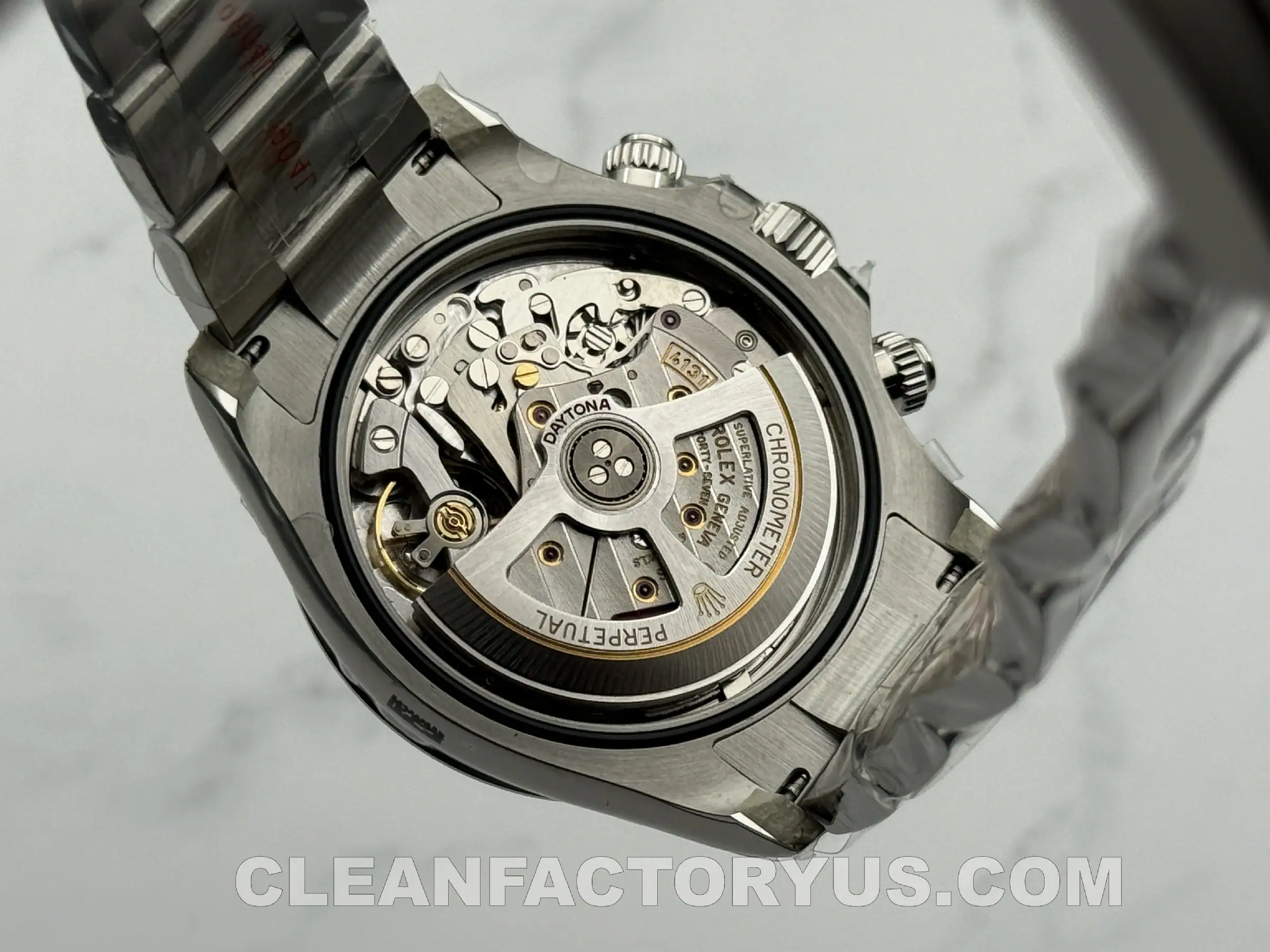
Inside the watch is a cloned 4131-style automatic chronograph movement. Product-page descriptions usually try to turn this into a miracle, but a more useful way to think about it is to ask how it behaves in actual use.
In everyday terms, the movement does what it needs to do. The seconds sweep is smooth, winding feels stable, crown operation is straightforward, and the chronograph functions engage with enough firmness to feel deliberate rather than fragile. That matters more than grand claims, because with a watch like this, the mechanical experience has to support the design rather than distract from it.
The pushers are especially important. On a weak chronograph, starting, stopping, and resetting can feel vague or overly light, which makes the whole watch feel less convincing. Here, the interaction is solid enough that the chronograph feels like a real part of the watch rather than a decorative extra.
Visually, the movement is designed to resemble the modern Daytona caliber family, and that matters for buyers who care about more than just the front-facing parts of the watch. But in practical use, its biggest strength is simply that it feels coherent. The hands move cleanly, the chronograph behaves properly, and the watch does not feel mechanically awkward.
That said, this is still one of the places where the boundary remains clear. The movement can look the part and function well, but it is not a true equivalent to the original 4131 in architecture or long-term expectation. That difference is real. The good news is that in day-to-day wear, most of what the owner actually interacts with feels stable and mature enough to support the overall package.
Where the Clean Factory Daytona still feels like a replica
A balanced review should say clearly that this watch still exists within the normal limits of a high-end replica. It is not beyond scrutiny, and it does not turn the Daytona into a solved problem.
Collectors who know the genuine watch well can still find details worth debating, especially under direct comparison or magnification. Tiny differences in finishing, micro-proportions, and movement construction do not disappear just because the overall package is strong. Over time, individual examples may also reveal the usual variances that come with replica production, whether in regulation, bracelet feel, or the crispness of minor details.
And because the Panda Daytona is such a well-known design, it remains one of the least forgiving watches in the category. A less iconic reference can sometimes get away with small imperfections because fewer people know what to look for. The white ceramic Daytona does not have that luxury.
Still, there is a difference between saying a watch has limits and saying it lacks merit. What makes this version noteworthy is that the remaining gap is no longer about broad design identity. It is mostly in the last layer of detail, where collectors and experienced observers naturally begin to separate the excellent from the truly original.
Final thoughts: a strong Clean Factory build, not a perfect illusion
The strongest part of this watch is not that it tries to overwhelm the reader with claims, but that the Clean Factory Rolex Daytona feels well resolved as a whole.
The case proportions are controlled, the dial and bezel work together naturally, and the watch carries the right kind of visual tension on the wrist. Compared with the genuine 126500LN, there are still limits in the finer details and in the movement beneath the surface. That part is real, and it should be acknowledged.
But the more interesting point is how much of the original design language this version manages to preserve without feeling forced. As a modern super clone Rolex, it works best when judged as a complete object rather than a checklist of isolated parts.
That, more than anything, is what gives this watch its appeal.


