

There is no high quite like unboxing a brand-new mechanical timepiece. You peel off the protective plastics, unscrew the crown to set the time, strap it onto your wrist, and admire the sweeping seconds hand. But then, a few hours later—or perhaps the next morning—you look down, and your stomach drops.
The watch has completely stopped.
The instant psychological reaction is usually a mix of embarrassment and intense frustration. “Did I just buy a lemon? Is the movement defective?”
Before you fire off an angry email to customer service or spiral into buyer’s remorse, take a deep breath. Your watch isn’t broken. It’s just experiencing a classic mechanical phenomenon: The Chronically Starved Mainspring.
Here is the definitive guide to understanding why your automatic watch stops, how to fix it, and the hard truth about the ultimate enthusiast accessory: the watch winder.
1. The Desk-Worker’s Trap: The Myth of “Perpetual” Power
Most modern luxury and sports watches feature automatic (self-winding) movements. Because marketing materials often tout these as “powered by your everyday movement,” many new collectors assume they never need to be manually wound.
This is a dangerous misconception. An automatic rotor relies entirely on active, kinetic energy. If your daily routine involves sitting at a desk, typing on a laptop, or commuting in a car, your wrist simply isn’t generating enough centrifugal force to fully wind that heavy mainspring.
Think of your watch’s power reserve like a bank account. To keep the watch alive, your daily deposits (kinetic movement) must equal or exceed your daily withdrawals (the 24 hours of energy the watch consumes to tick).
Let’s look at the math of a classic “Winding Deficit”:
- Your watch consumes 24 hours of energy per day.
- Due to a sedentary lifestyle, your wrist movement only charges the mainspring by 20 hours per day.
- Each day, your watch is running a 4-hour deficit, eating into whatever initial reserve it had.
In the beginning, the watch seems fine because it has a tiny bit of leftover juice from when you first shook it. But after about a week of working in this “half-starved” state, the bank account hits zero. The watch suddenly dies in the middle of the night, leaving you baffled. Furthermore, running a watch on low tension drops its balance wheel amplitude, causing severe accuracy errors long before it actually stops.
2. The Quickstart Guide: The 25-Turn Rule
To prevent your watch from living paycheck-to-paycheck, you need to provide it with a solid financial cushion—a full “savings account” of power. Whenever you receive a new watch, or if your watch has been sitting dead in your drawer, you must perform a manual initial wind.
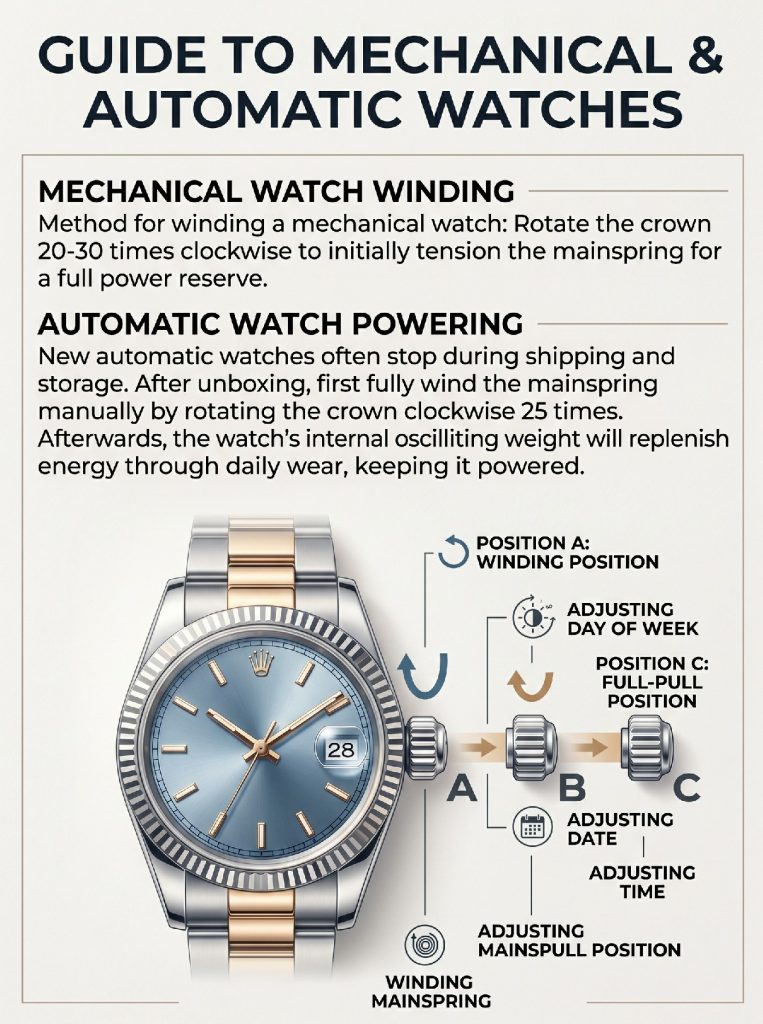
[ Crown Position A ] ─── Winding Position (Flush against the case / unscrewed)
[ Crown Position B ] ─── Quick-set Date / Day Adjustment
[ Crown Position C ] ─── Time Setting (Seconds hand stops)
- Locate Position A: Ensure the crown is in its primary position (Position A). If it’s a dive watch, unscrew it until it pops out to the winding position, but do not pull it out to change the date or time.
- The 25-Turn Rule: Slowly rotate the crown clockwise (forward) 20 to 30 times (25 turns is the sweet spot). You will feel a slight, smooth resistance—this is the mainspring coiling tightly inside its barrel. You cannot over-wind a modern automatic watch; a built-in safety clutch (slipping bridle) prevents it from snapping.
- The Morning Routine: It is highly recommended to do this quick manual top-off in the morning. When a watch is fully wound at the start of the day, its timekeeping accuracy is at its absolute peak, and it becomes far more resilient to outside shocks, vibrations, and position changes during your daily hustle.
3. Enter the Watch Winder: Luxury Vault or Silent Killer?
Once collectors realize their daily movement isn’t enough, they naturally look for an automated solution. Enter the watch winder (or watch capsule)—a sleek, rotating box designed to mimic human wrist movement and keep your watches perpetually ticking.
It seems like the perfect solution, but if you look under the surface of the horology community, you’ll find a fierce debate: Is a watch winder actually good for your mechanical watch, or is it a silent killer?
The Pros: Convenience and Complications
The primary benefit of a watch winder is convenience. If you rotate through a multi-watch collection, picking up a dead watch means spending time resetting the perpetual calendars, moonphases, or annual calendars. On highly complex movements, resetting these interconnected gears can be a logistical nightmare, and doing it incorrectly can actually damage the mechanism. A winder eliminates this friction entirely.
The Cons: The Idling Car Analogy
If you ask a Rolex-certified technician their opinion on winders, you might get a surprisingly negative response. Their argument boils down to one word: Wear.
Think of your mechanical watch movement like a car engine. If you leave your car idling in the garage 24/7, you are accumulating mileage and wearing down the internal components, even if the odometer isn’t moving. Keeping a watch on a winder indefinitely means the gears, train wheels, and the automatic winding rotor are under constant friction. Furthermore, keeping the mainspring permanently compressed at 100% tension strains the safety clutch over time, leading to premature service intervals.
4. The Hidden Trap: Magnetization and Cheap Motors
The biggest danger of watch winders doesn’t come from the concept itself, but from low-quality manufacturing.
Inside every watch winder is an electric motor. Cheap, unbranded winders sold across online marketplaces often use poorly shielded electric motors that emit a constant stray magnetic field.
If you place a delicate mechanical watch directly over an unshielded magnetic field for 12 hours a day, the hairspring inside the balance wheel will eventually become magnetized. Once magnetized, the coils stick together, causing your watch to suddenly run incredibly fast—gaining minutes or even hours a day.
5. How to Use a Winder Correctly: The TPD Blueprint
If the convenience of a winder outweighs the wear and tear for your lifestyle, you must use it correctly. You cannot just buy a cheap box that spins infinitely. You need a programmable winder where you can control TPD (Turns Per Day) and Direction.
Most modern luxury movements (like the Rolex Caliber 3235) require between 650 to 800 TPD.
| Watch Movement / Style | Recommended TPD | Directional Setting |
| Rolex Caliber 3235 / Submariner | 650 – 700 | Bi-directional (Both) |
| Patek Philippe Caliber 324 | 800 | Counter-Clockwise |
| Valjoux 7750 (Chronographs) | 800 | Clockwise Only |
A proper, high-end winder will spin for a few minutes, drop into a sleep cycle for an hour, and then spin again, mimicking natural human wrist movement rather than over-stressing the caliber.
The Ultimate Verdict
Do you need to panic if your automatic watch stops? No. It’s a normal mechanical boundary of a sedentary modern lifestyle. Give it a solid 25-turn manual wind to kickstart its heart.
Should you buy a watch winder to solve it?
If your daily rotation consists of simple Time-and-Date sports watches (like a standard Submariner or a GMT), save your money and let the watch rest when it’s off your wrist. It takes less than a minute to hand-wind them, and you avoid unnecessary mechanical wear. However, if you are a collector managing complex calendar complications, or if you simply value a “grab-and-go” lifestyle, a watch winder is an incredible asset—provided you invest in a high-quality, magnetically shielded unit with programmable TPD settings.


