Rolex watches are among the most recognizable luxury timepieces in the world, making them frequent targets for imitation. Older low-quality copies often reveal themselves through obvious printing errors, lightweight bracelets, or inexpensive quartz movements. Modern counterfeits, however, utilize sapphire crystals, ceramic bezels, high-beat mechanical movements, and meticulously reproduced engravings.
Learning how to tell if a Rolex is real requires far more than checking a logo or watching the sweep of a second hand. A proper assessment considers the complete watch: its dial, case, bracelet, movement architecture, reference details, production period, documentation, and seller history.
Most importantly, no single visual test can guarantee authenticity. Rolex officially states that only the brand can definitively confirm the authenticity of a Rolex watch. New watches purchased through Official Rolex Retailers are guaranteed authentic, while eligible Rolex Certified Pre-Owned watches are authenticated, serviced, and tested through the brand’s own program.
The Quick Answer
To determine whether a Rolex may be genuine, evaluate the following key areas:
- Dial printing clarity and hour-marker alignment
- Rolex coronet definition and applied detail finishing
- Date window alignment and Cyclops magnification strength
- Sapphire crystal characteristics and inner rehaut engravings
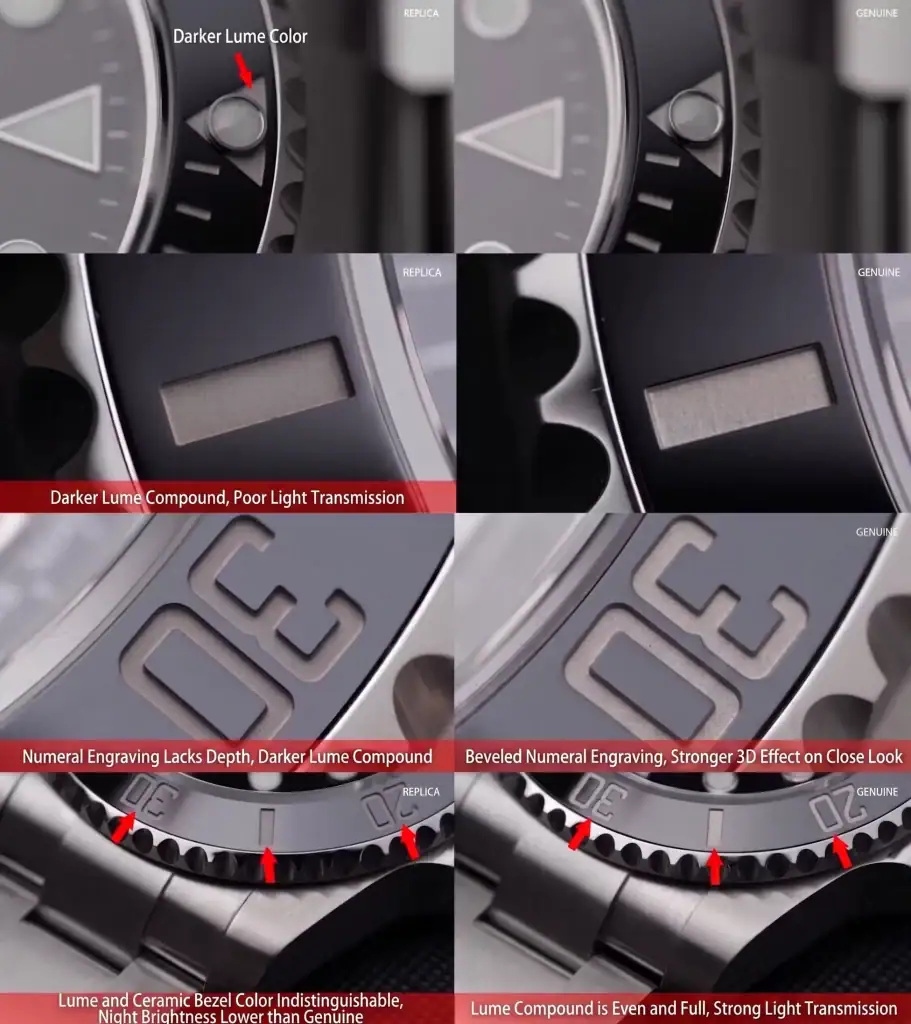
- Hands, edges, and luminous material application
- Case geometry, surface finishing, and overall weight
- Bracelet tolerances, end-link fit, and clasp mechanics
- Winding crown operation and calendar complication functions
- Movement construction and balance wheel architecture
- Reference numbers, serial details, paperwork, and seller reputation
Each check provides supporting evidence. None should be treated as definitive when used in isolation.
1. Examine the Rolex Dial Printing and Font Alignment
The dial is one of the primary inspection zones because it contains numerous microscopic details that must work in complete harmony.
On a genuine Rolex dial, all text under magnification should appear:
- Clean and sharply defined with zero ink bleeding
- Perfectly centered relative to dial markers
- Evenly spaced across every line
- Consistent in typography depth and thickness
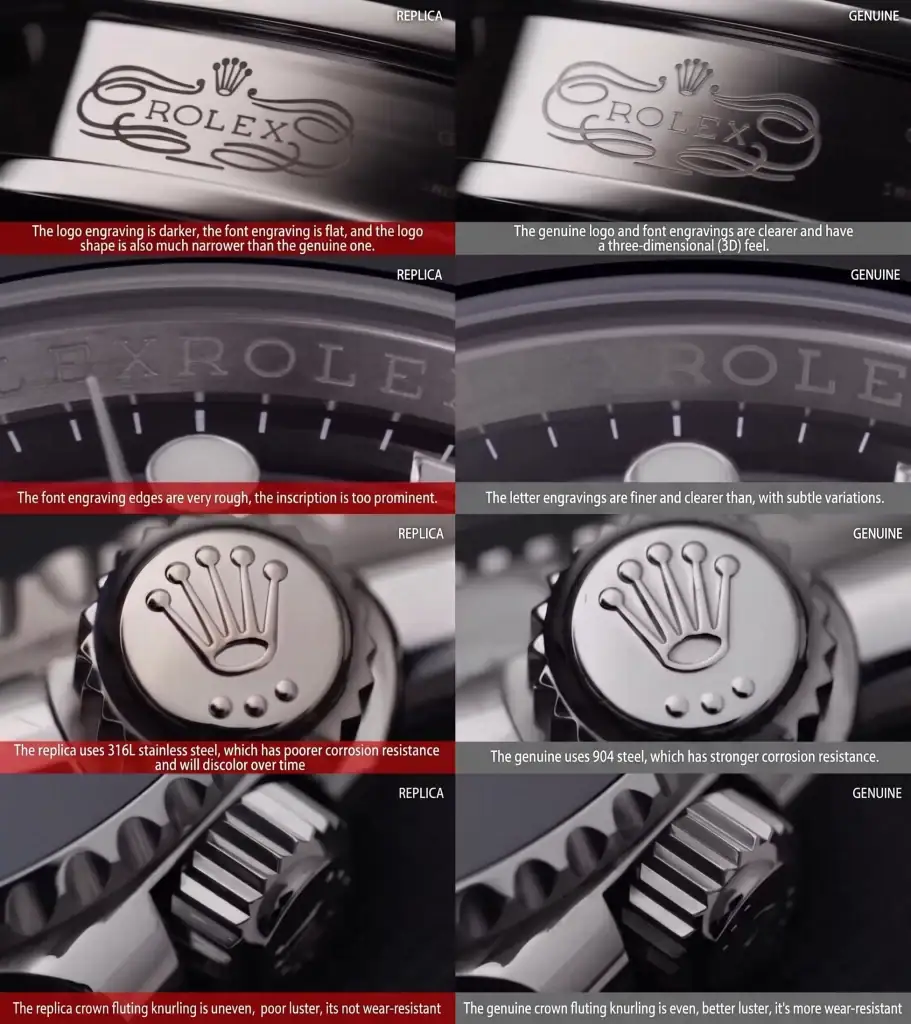
The Rolex coronet at 12 o’clock should display balanced proportions and clearly formed points. Applied hour markers should sit perfectly flush and align accurately with the minute track. Visible glue residue, uneven marker placement, distorted lettering, or inconsistent line spacing indicate quality control issues uncharacteristic of genuine manufacture.
Dial details vary significantly by reference and production era. Fonts, coronet proportions, depth-rating text, minute tracks, and luminous materials have evolved over decades. A dial must always be compared against a verified example of the exact same reference and approximate production year.

2. Check the Date Window and Cyclops Magnification Lens
Many Rolex models equipped with a calendar display feature the iconic Cyclops magnifying lens positioned on the sapphire crystal above the date aperture.
On authentic models, look for:
- Strong, clear 2.5x date magnification
- A date numeral that fills the aperture cleanly and reads easily
- Precise centering of the numeral inside the window
- Anti-reflective (AR) coating performance on the lens
- Clean, seamless alignment between the lens and the crystal surface
Weak magnification, a small-looking date numeral, or a crooked lens indicate improper construction. However, not every Rolex reference features a date display, and historical crystal configurations vary. Modern high-tier manufacturers can also reproduce strong magnification, meaning the Cyclops should be treated as one component of a broader inspection.
3. Inspect the Sapphire Crystal and Rehaut Engravings
Many modern Rolex sapphire crystals feature a micro-laser-etched coronet near the 6 o’clock position. This marking is intentionally subtle and typically requires magnification and angled lighting to spot.
A coronet that is excessively large, deeply etched, or immediately obvious without magnification warrants closer scrutiny. Conversely, the absence of this etching does not automatically signal a counterfeit, as older references (pre-2002) and certain service replacement crystals lack this feature.
The rehaut—the inner metal ring surrounding the dial beneath the crystal—provides crucial details on modern references:
- Clean, laser-etched “ROLEXROLEXROLEX” lettering
- Sharp, consistent engraving depth with no ragged edges
- Precise alignment where the letters align perfectly with the minute markers
- A serial number engraved at the 6 o’clock position corresponding to official records
4. Study the Hands, Markers, and Luminous Material
Rolex hands and applied hour markers are crafted from precious metals (typically 18k gold) to prevent tarnishing. Under high magnification, their edges display clean, controlled polishing without burrs or rough stamping marks.
Potential red flags include:
- Rough or jagged hand edges
- Misaligned hour markers or uneven hand stacking
- Visible adhesive around marker bases
- Inconsistent luminous material fill
- Unexplained color differences between hand lume and dial lume
Luminous performance should match the watch’s age and specification. Modern references feature bright Chromalight (glowing blue) or Superluminova (glowing green), whereas vintage pieces may utilize aged Tritium or Radium with diminished luminescence.
5. Evaluate Case Geometry and Surface Finishing
A genuine Rolex case displays crisp, controlled transitions between polished and brushed surfaces. The lugs, crown guards, bezel fluting, and case sides follow strict geometric specifications.
Examine the case for:
- Symmetrical lug proportions
- Consistent brushing direction across surfaces
- Defined, sharp chamfers and transitions between finishes
- Properly proportioned crown guards that hug the winding crown
- Profile dimensions that match official reference specs
Poor finishing suggests an imitation. However, excessive polishing on an authentic watch can also soften case lines, thin out the lugs, and alter original proportions—a critical factor when evaluating pre-owned value.

6. Compare Weight Against the Exact Configuration
Rolex watches possess a reassuring, balanced heft, particularly modern references crafted with solid 904L stainless steel (Oystersteel), 18k gold, or 950 platinum. A watch that feels unusually light for its configuration warrants further investigation.
Weight comparisons must be conducted with extreme accuracy, taking into account:
- Case material (Steel, Rolesor, Gold, Platinum)
- Bracelet type (Oyster, Jubilee, President)
- Number of installed bracelet links
- Case diameter and movement caliber
Comparing a steel reference against a precious-metal model produces misleading results. Furthermore, high-grade modern counterfeits intentionally utilize heavier steel alloys to match genuine weight specs closely, making weight a preliminary screening tool rather than final proof.
7. Inspect the Bracelet, End Links, and Clasp Assembly
The bracelet should align seamlessly with the case architecture. On modern references, the solid end links (SELs), bracelet links, and clasp mechanism operate with micro-tolerances.
Look for:
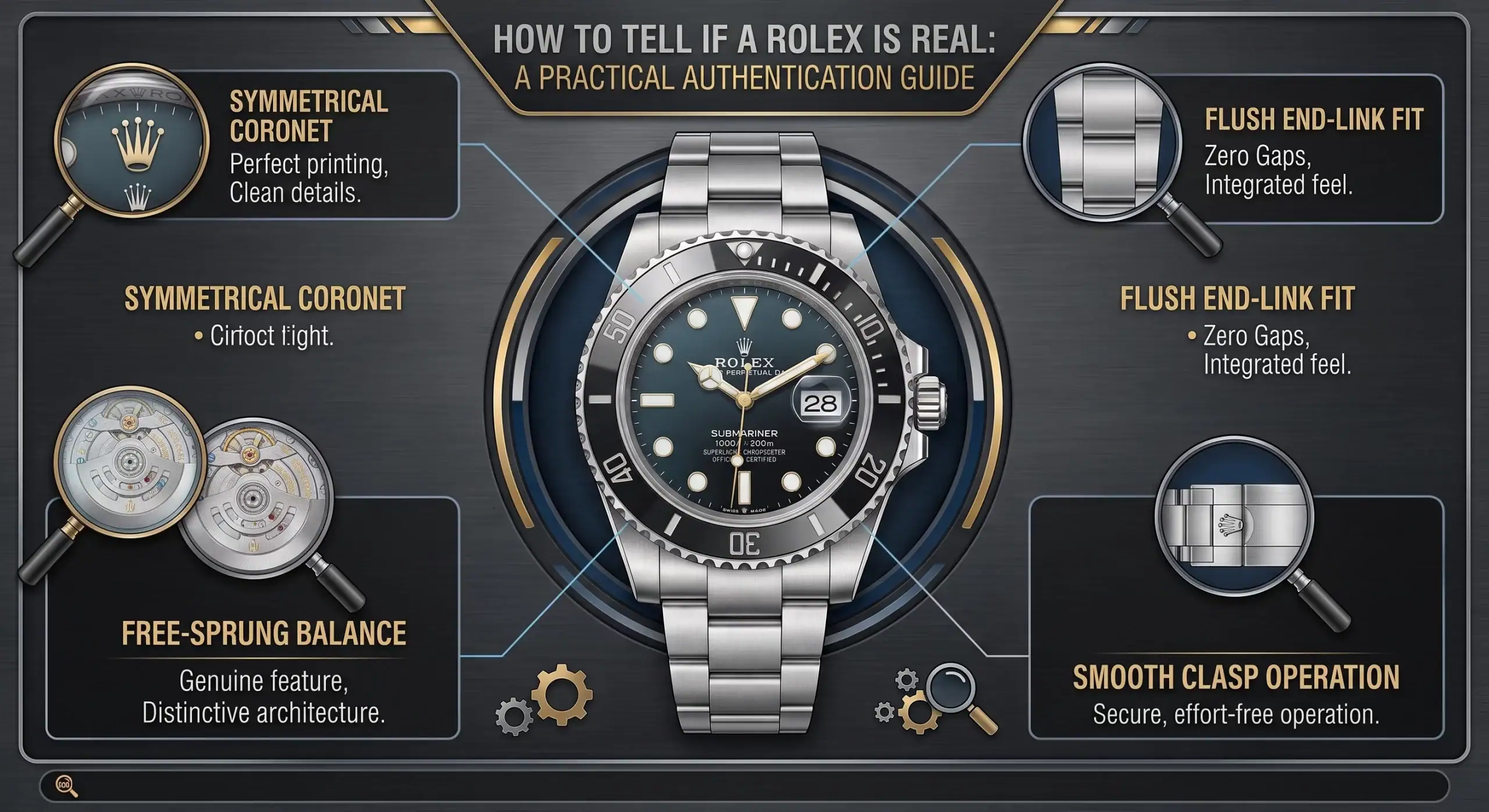
- End links that fit flush against the case with zero visible gap or play
- Smooth articulation across individual links
- Clean, evenly finished screw heads
- Crisp coronet and logo engravings on the clasp
- A smooth, secure closing action on the Oysterlock or Crownclasp
Loose construction, rough unfinished link edges, shallow stamping, or noticeable gaps indicate inferior manufacturing. Vintage folded-link or hollow-link bracelets naturally exhibit more play (“stretch”) due to age, which should not be confused with counterfeit construction.

8. Test Winding Crown Mechanics and Complication Functions
Unscrew and operate the winding crown carefully. The threading should feel smooth, engaging the case tube cleanly when screwed down to seal the Oyster case.
Depending on the specific movement caliber, verify:
- Smooth manual winding resistance
- Instantaneous date-change snap at midnight (rather than a slow transition)
- Independent jumping hour hand adjustments (on GMT-Master II models)
- Precise chronograph pusher engagement and reset alignment (on Daytona models)
Grinding, loose resistance, or slipping mechanics can indicate internal movement issues, which may occur on either a counterfeit watch or an authentic timepiece requiring service.
9. Do Not Rely on the Second Hand Sweep Alone
A persistent misconception claims that every real Rolex exhibits a perfectly continuous, fluid second hand sweep, while counterfeits tick once per second.
In reality, modern mechanical Rolex calibers operate at a frequency of 28,800 vibrations per hour (4Hz), which translates to 8 subtle micro-steps per second. While smooth to the naked eye, it is not a uninterrupted glide. Modern mechanical clone movements operate at this exact same frequency.
Furthermore, authentic quartz Rolex models exist—including historical Oysterquartz references—which tick once per second by design.
- A one-second tick reveals a quartz movement where a mechanical caliber belongs
- A smooth 8-step-per-second sweep does not prove authenticity
- Movement mechanics must always match the specific reference history
10. Inspect the Movement: The Super Clone Era (Dandong 3285 & 3235 Benchmarks)
The movement remains the single most critical component in authentication. However, inspecting the caliber now requires an understanding of modern manufacturing advances.
The Rise of 1:1 Super Clones
Historically, opening a caseback exposed cheap ETA or Miyota movements fitted with crude, glued-on decorative plates. Today, top-tier clone manufacturers—most notably Clean Factory—utilize custom 1:1 integrated calibers, such as the Dandong 3285 (for GMT-Master II models) and Dandong 3235 (for Submariner models).
These movements duplicate the exact architectural layout, bridge shapes, laser engravings, independent jumping hours, and even deliver a true 70+ hour power reserve mirroring genuine Rolex specifications.
Because clone calibers now replicate general visual architecture and functionality, watchmakers inspect microscopic details under high magnification:
- The Balance Assembly: Genuine Rolex Calibers (3235/3285) feature a true Free-Sprung Balance Wheel with gold Microstella regulating screws. Clone calibers frequently still utilize an index regulator arm arrangement.
- Escapement and Finishing: Genuine movements showcase Rolex’s proprietary skeletonized Chronergy Escapement, refined beveling on movement bridges, and precise ruby jewel setting depths.
- Hairspring Configuration: Genuine modern calibers utilize a blue Parachrom hairspring with a distinctive Breguet overcoil, crafted for antimagnetic stability.
A movement inspection by a qualified watchmaker remains the most decisive test, but it demands an understanding of the subtle differences between authentic manufacture movements and latest-generation super clone calibers.
11. Verify Reference Numbers, Serial Details, and Engravings
Reference and serial numbers establish whether a watch’s components are internally consistent.
Depending on the generation:
- Pre-2007: Engraved between the lugs at 12 o’clock (reference) and 6 o’clock (serial)
- Post-2007: Engraved on the inner rehaut at 6 o’clock
The reference number must align precisely with the correct case diameter, material, bezel configuration, and dial style. Red flags include shallow laser etching, incorrect typography, or serial numbers that appear repeatedly across online counterfeit databases.
12. Understand That Box and Papers Are Not Absolute Proof
A full set may include:
- Outer and inner presentation boxes
- Guarantee card or paper certificate
- Instruction manuals and warranty booklets
- Serialized hang tags and service records
While complete documentation enhances provenance and collector value, accessories can be duplicated or paired with a watch after the fact. The reference number, serial number, sale date, and retailer details listed on the guarantee card must match the physical watch exactly.
Authenticity vs. Originality
When evaluating pre-owned luxury watches, understand the distinction between authenticity and originality:
- Fully Genuine & Original: All major components are authentic to Rolex and remain in their original factory configuration.
- Genuine with Rolex Service Parts: The watch is authentic, but components (such as hands, dial, or bezel) were replaced during official service.
- Genuine with Aftermarket Parts: The base watch and movement are authentic, but custom non-Rolex components (such as gem-set bezels or custom dials) have been added.
- Composite (“Frankenwatch”): Assembled using a mix of genuine parts from various references alongside non-genuine components.
- Fully Counterfeit: Case, movement, dial, and bracelet are manufactured entirely to simulate a genuine Rolex.
Quick Rolex Authentication Checklist
| Inspection Area | What to Verify | Key Limitation |
| Dial | Text sharpness, marker alignment, coronet proportions | Printing details vary by era |
| Cyclops | 2.5x magnification, date window centering | Modern clones replicate magnification well |
| Crystal / Rehaut | Micro-etched coronet at 6, aligned rehaut text | Etchings can be mimicked |
| Hands & Lume | Metal finishing, clean edges, correct lume glow | Service hands may show newer lume |
| Case Finishing | Sharp chamfers, brush/polish contrast | Polishing alters original geometry |
| Weight | Solid feel matching exact material spec | Clones use weighted steel alloys |
| Bracelet | Flush end-link fit, smooth articulation, crisp clasp | Vintage bracelets naturally show stretch |
| Movement | Caliber architecture, Free-Sprung balance, Chronergy wheel | Super clones (Dandong 3285/3235) replicate 70-hr power reserves |
| Serial / Papers | Matching numbers between watch and warranty card | Papers and serials can be duplicated |
Final Thoughts
Determining whether a Rolex is genuine is a process of confirming that every individual component tells the exact same technical story. The dial font must match the reference period, the case finishing must reflect factory tolerances, and the internal movement caliber must stand up to microscopic examination.
When purchasing pre-owned timepieces, the safest approach combines thorough physical inspection with buying from established specialists who provide written authenticity guarantees, clear return policies, and independent inspection allowances.